Paul Graham on Why Billionaires Build

The ideal combination is the group of founders who are “living in the future” in the sense of being at the leading edge of some kind of change, and who are building something they themselves want. Most super-successful startups are of this type. Steve Wozniak wanted a computer. Mark Zuckerberg wanted to engage online with his college friends. Larry and Sergey wanted to find things on the web. All these founders were building things they and their peers wanted, and the fact that they were at the leading edge of change meant that more people would want these things in the future.

From: http://paulgraham.com/ace.html

Yeah, I’m gonna go ahead and call BS on this. There’s nothing in the public record that makes me think that Zuckerberg had “friends” he wanted to connect with, or that Larry and Sergey couldn’t already find “things” on the web with Alta Vista or Yahoo! at the time. This is just revisionist billionaire protectionism.

Paul is trying to share well-known startup examples which prove that the average billionaire-founder isn’t building their empire on exploitation, but those two examples might be the most counterproductive that he could have possibly used. Both of these are of people who saw a business opportunity to exploit people’s behavior online to sell advertising, and built products to surreptitiously profit from it. If there was any consideration of building a better mousetrap, it was only to trap more mice for the purpose of milking them; not delighting them.

That, not exploiting people, is the defining quality of people who become billionaires from starting companies. So that’s what YC looks for in founders: authenticity. People’s motives for starting startups are usually mixed. They’re usually doing it from some combination of the desire to make money, the desire to seem cool, genuine interest in the problem, and unwillingness to work for someone else. The last two are more powerful motivators than the first two. It’s ok for founders to want to make money or to seem cool. Most do. But if the founders seem like they’re doing it just to make money or just to seem cool, they’re not likely to succeed on a big scale. The founders who are doing it for the money will take the first sufficiently large acquisition offer, and the ones who are doing it to seem cool will rapidly discover that there are much less painful ways of seeming cool.

Here’s where the wheels really come off his “essay.” All of the recent startups that have made the national consciousness — like GrubHub, Bird and Lime, and especially Uber and Lyft — all of them rely on exploiting underemployed people. Most people don’t realize how much it costs to employ someone, and traditional companies have borne a lot more than people understand. All of the “gig economy” work — as currently engineered — is exploitative, seeking to offload the burden (to us the technical term) of employing someone. If a person in a “gig-economy” job would factor in those costs, like wear-and-tear on their vehicle, or the increased insurance cost (that people should be taking out), a lot of people would find that they are actually losing money working for these companies in a “gig economy” position.

You can look at a simple chart of expanding productivity vs. flat realized income over the past 40 years, and quickly see that “trickle-down” economics hasn’t fulfilled it’s stated promise (no matter how much Rush Limbaugh tries to brainwash you otherwise), but the downward pressure on income for the past 10 years is coming more from exploitative “web 2.0”-type companies than traditional manufacturing, and the fact that the dot-com billionaire class, pushing the gig-economy, has been able to largely avoid scrutiny for that is proof that they’re rigging the game through the influence and cover their social-media-focused products can provide.
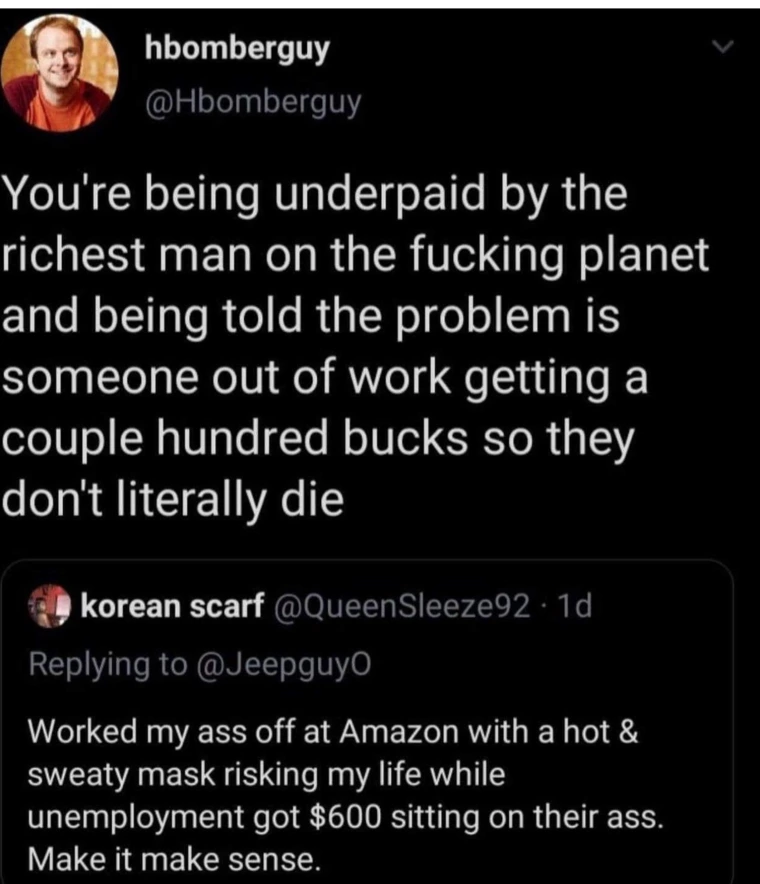
Graham’s “essay” is a joke because he — representing billionaires — and I — representing the other 7 billion other people on the planet — are talking about two different things. He defines “exploitation” as, say, child labor in the Orient, when the rest of us are defining it as “not making a fair deal with someone for their time.” Then, Graham ascribes political pressure to push the scales of balance of this trade back to the middle to simple jealousy, and that’s when his true colors really shine. Not only is he deluding himself about what it takes to exploit someone, he’s accusing people having a problem with the situation as being affected by base emotions, which are easily dismissed.

The most reliable way to become a billionaire is to start a company that grows fast, and the way to grow fast is to make what users want. Newly started startups have no choice but to delight users, or they’ll never even get rolling. But this never stops being the lodestar, and bigger companies take their eye off it at their peril. Stop delighting users, and eventually someone else will.

Stop it. Just stop it. You’re making yourself look silly, now, Paul. It’s been a long, long time since YouTube, Facebook, Amazon, or Twitter “delighted” anyone. They are all predatory monopolies now — with nation-state-level influence — and they are all exploiting people and gaming governments to stay that way. Google and Amazon, in particular, were delightful, 20 years ago, when they gave us things like Google Reader, and the ability to block sites from search results we found counter-productive,  or highly-curated, highly-rated selections to choose from, with high-quality reviews to help make a selection. Now that they’ve achieved monopoly positions in their market, they no longer have to trouble themselves with such things as being easy or helpful to use.

In the old days, wildly successful companies and people would at least be expected to pay an increasingly-significant level of tax, but quiet changes to the tax laws over the past few decades has essentially given us a flat tax on income, and zero tax on corporations. Bezos is on track to becoming the first trillionaire by the time he dies, while the national debt has risen to $30 trillion dollars, and half the country is struggling to pay rent. The executives at all of these companies almost certainly pay less income tax, on a percentage basis, than I do. It seems like something has become seriously misaligned in our economy here, and I wonder how bad it’s going to have to get before something is forcibly done about it.


Posted in Technology | Tagged , | Leave a comment

Even If It’s ‘Bonkers,’ Poll Finds Many Believe QAnon And Other Conspiracy Theories

Misinformation about the election and the coronavirus is also gaining a foothold in American society, according to a new NPR/Ipsos poll.

Source: Even If It’s ‘Bonkers,’ Poll Finds Many Believe QAnon And Other Conspiracy Theories

The poll results add to mounting evidence that misinformation is gaining a foothold in American society and that conspiracy theories are going mainstream, especially during the coronavirus pandemic. This has raised concerns about how to get people to believe in a “baseline reality,” said Chris Jackson, a pollster with Ipsos.

You have to somehow square this with the fact that hundreds of mainstream news organizations, Twitter, Facebook, and Google exist — in the presence of pervasive internet access, and nearly ubiquitous ownership of small, networked computers — and put all information online, in realtime, available to everyone. In other words, this is happening when there is the least amount of friction in getting facts into people’s heads than ever before, and one can scarcely imagine making that process any easier.

“Increasingly, people are willing to say and believe stuff that fits in with their view of how the world should be, even if it doesn’t have any basis in reality or fact,” Jackson said.

I don’t think this is particularly new. The desire and the effort to bend the world to one’s own view of it has always been present. It’s the infinite spectrum of information, and the now-essentially-infinite supply of content at any point in that spectrum, that satiates this desire. No matter what you want to believe, you can find enough sources confirming that belief to convince yourself that you have a complete mental picture of the situation. The deluge of cherry-picked information has made it far easier to believe whatever you want to believe, and find support for that, than to try to separate the wheat from the chaff, recognize disinformation, and form an objective opinion based on the most-credible interpretation of the facts.

The term I use is “converge.” You have to keep reading disparate sources until facts converge. And that takes a lot of mental effort. Not only that, but in many examples of high-profile, widely-covered political stories — upon which people will hang their political identities — the stories never converge to form a clear picture of what actually happened. As more and more people report more and more arcane facts and figures about highly-controversial issues, this problem is on-track to get even worse.

#SocialMediaIsDestroyingSociety

A group of Satan-worshipping elites who run a child sex ring are trying to control our politics and media.

The article goes out of its way to highlight absurdity of the question, and disparage anyone who responded “yes” to it. But someone is going to have to help me understand why this question should be considered absurd when someone broke into a highly-secured, solitary-confinement wing of a prison, disabled all of the security cameras, and murdered an extremely well-connected underage-human sex trafficker — to prevent him from naming names at the highest levels of governments all over the world — and then evaded all investigation. If that doesn’t speak to a conspiracy of elites at least indifferent to the running of a child prostitution ring to you, then I don’t know what other events would have to have happened in that chain to flip your opinion on the matter. Those events alone should be enough to substantiate the bulk of the theoretical statement. I mean, is Ipsos’ addition of the “Satan-worshipping” clause supposed to flip the whole statement to the side of absurdity? And right there, we getting into the disinformation and manipulation of the facts that people can point to as the cause of all the societal problems the article is decrying.

UPDATE: I see now, from the Wikipedia article, that the whole “cabal of satan-worshipping cannibalistic pedophiles” thing is the basis of QAnon itself. You’ll have to forgive me if I try to avoid reading too closely on either side of the political divide.

Posted in Politics | Tagged , | Leave a comment

Extract or Die – Pirate Wires

Among many things, including talent, opportunity, and soft power, the technology industry has brought tremendous tax revenue to the Bay Area. The budget of San Francisco literally doubled this decade, from around six billion to over twelve billion dollars. With our government’s incredible, historic abundance of wealth, the Board of Supervisors has presided over: a dramatic increase in homelessness, drug abuse, crime — now including home invasion — and a crippling cost of living that can be directly ascribed to the local landed gentry’s obsession with blocking new construction. This latter piece is important, as it appears to be the only thing our Board cares about. This is because significantly increasing the local housing supply would decrease the value of the multi-million dollar homes almost every single one of our Supervisors owns, and we could never have that.

Source: Extract or Die – Pirate Wires

This is the most-direct analysis I have seen of why Silicon Valley has become the most overpriced area in which to live in the US. The situation described here is heart-wrenchingly discouraging, but what’s completely and utterly heart-breaking is that nothing seems to be getting learned by it. I’ve watched the San Francisco housing market from afar — with no small amount of schadenfreude — for many years now. They’ve been on this course for a couple of decades or more, and it just keeps getting worse. Instead of enacting any policies to help matters, they keep doubling down on the liberal policies and NIMBY-ism that has gotten them into such a sorry state of affairs to begin with.

Posted in Politics | Tagged , , , | Leave a comment

Homeshoring

Thanks to Covid-19, everyone who can be has been “homeshored.” The cost savings for companies “allowing” employees to work from home must be staggering. They’ve offloaded their spending on HVAC, power, water, internet bandwidth, office supplies, coffee, and toiletries to the employees. I expect homeshoring to continue, in large part, after Covid-19 is “over” (however that is defined).

The counter argument is what to do about onboarding new employees? How will they ever get integrated into their local workgroup, or the company culture, if they’re only interactions are stilted video conference calls? It’s a depressing thought. Many people are decrying how impersonal modern life is becoming, and what the lack of interpersonal relationships is doing to our society, and this trend doesn’t bode well for this either.

Posted in Technology | Tagged , | 1 Comment

Thank You, Javascript

In the vein of Jimmy Fallon’s “thank you notes” bit: Thank you, Javascript, XHR, and ad tech for making the modern web basically unusable on $1,000 phones with 4G LTE connections. This situation is patently ridiculous.

Posted in Humor | Tagged , , | Leave a comment

The beautiful Silent ThunderBolt-3 PC

I looked for hubs supporting 4k60 and USB-3 and read many good things about the CalDigit TS3 Plus.

Source: The beautiful Silent ThunderBolt-3 PC

Once again, the CalDigit TS3+ saves the day. Mine’s been a real lifesaver for using my 2019 MacBook Pro, primarily in “clamshell” mode.

Posted in Technology | Tagged , , | Leave a comment

Dominion Machine Statistical Problems

This whole Twitter thread. It’s another, completely-independent way of looking at the voting data, like The 2020 Election, Benford’s Law, and Twitter, and it’s another smoking gun that indicates that the voting machines — in precisely the places that needed help — have been tampered with. Again — and I can’t stress this enough — the courts need a protagonist. You can’t just prove this by math. You have to show that some person hacked the machines, and you will never be able to do that. There’s too much obfuscation and redirection. So I’m more and more convinced that the election was stolen, but that Biden got away with it clean. This has been done so well, that I’m convinced “dissidents” in one of the three-letter agencies — with experience in this sort of thing in other countries — had to have been involved.

If the election was really, truly hacked, then Republicans in Congress have to do something about it, lest they lose another election because of it. The real question — the only question, at this point — is what they will do about it. The real story will get around, whispered in the back rooms of Washington office buildings. The people who could do something about this will eventually know what really happened here. The thing to watch is what happens to voting machines before the next election. That will be the last piece of this puzzle.


Posted in Politics | Tagged , | 1 Comment

Google Outage, from “Hacker” “News”

That last line, though…

Posted in Technology | Tagged , , , | Leave a comment

What Really Happens if You DESTROY Every Faction Immediately in Fallout 4? – YouTube

I’m playing through Fallout 4 — again — while I wait — interminably — for the new Playstation. This guy is talking about a mod that makes it possible to destroy every faction, and I haven’t gotten very far into the explanation, but, as he’s talking, a proper nuke explodes in the middle of the Castle, and this quest name pops up:

Your Settlement Does Not Need My Help

And at this point, I lost it, and laughed so hard that my stomach hurt. Overall, it was a pretty good video.

Posted in Gaming | Tagged | Leave a comment

Supporting the 2020 U.S. election

Yesterday was the safe harbor deadline for the U.S. Presidential election and enough states have certified their election results to determine a President-elect. Given that, we will start removing any piece of content uploaded today (or anytime after) that misleads people by alleging that widespread fraud or errors changed the outcome of the 2020 U.S. Presidential election, in line with our approach towards historical U.S. Presidential elections. For example, we will remove videos claiming that a Presidential elections. For example, we will remove videos claiming that a Presidential candidate won the election due to widespread software glitches or counting errors. We will begin enforcing this policy today, and will ramp up in the weeks to come.

Source: Supporting the 2020 U.S. election

People are crowing about how repealing section 230 of the Communications Decency Act would put too much burden on companies like Facebook, Twitter, and YouTube. They say it would be so costly to implement that it would effectively put them all out of business. But they’re happy to implement real-time screening for any and all copyrighted music posted to their platforms, even if it’s momentary or in the background. And now they’re apparently happy to police their content for things the government finds too controversial.

Who does it hurt to leave up videos about potential election fraud? The courts have soundly shut down the investigations. Any objective person would have to conclude that there is “no there, there.” And, yet, if you you’re were planning to steal an election by tampering with mail-in ballots and voting machines, the very second thing you’re going to do is plan to avoid being shown to have done so.

I don’t think there’s enough evidence to conclude anything either way about the election and possible fraud, but there seem to be enough curious situations to have happened that I’d love to see another documentary like The Great Hack, which showed the connections between the Trump campaign, and a successful manipulation of social media in his favor in 2016.

Our country is a captured regulatory body, only doing the bidding of the largest campaign donors, at the expense of smaller competitors. These mammoth companies get to do whatever they want. They will not allow themselves to be treated as a public service, even though they are. And they do just enough to appease people in the government so as to avoid being tasked with actually censoring their platforms for actual offensive content. So they walk this nauseating middle road of only censoring things that a small group of unpopular people are posting, and that’s the worst form of it. Either censor your platform, or don’t. If you’re removing content about election fraud, then I don’t want to see anything about 9/11 being an inside job, or how the Illuminati are running the world, either.

Posted in Technology | Tagged , | Leave a comment