Playstation 5 and Skyrim

I’ve been continuing to play through Skyrim on my PS5, and enjoying the extra graphical power. Someone has released some mods that allow you widen the field of view, and crank up the FPS to 60 (or unlimited). Since I’m stuck at 1080p for now, naturally, it works great, and still never slows down, even with the environmental mods. I’ll be very eager to try it at 4K@120FPS some day, but, for now, it’s a very welcome addition.

Someone pointed out that Fallout 4 (which is based on the same engine) can’t be modded this way. It needs to actually be patched by Bethesda to allow for this sort of thing. Here’s hoping that they do this. 60 FPS really is quite an improvement. I played a couple of seconds of Fallout 4, and quickly decided that I won’t be doing any more of that until the mod happens.

Posted in Gaming | Tagged , , | Leave a comment

Scam iOS Apps Still Raking in Millions in Revenue on App Store – MacRumors

As of writing, the scam app “Star Gazer+” is still listed on the App Store with 4.5 star average rating and over 80,000 reviews.

Source: Scam iOS Apps Still Raking in Millions in Revenue on App Store – MacRumors

As I keep saying on comment threads all over the internet: you cannot trust any review system. They’re all being gamed. They are worse than useless. They are actively hostile against users. Apple, Google… everyone should immediately take them all down and start over. Congress ought to ban Amazon’s system entirely. Right now. Forever. I’m not even joking. It’s that bad.

I guess I still give some credence to reviews on Steam, but only barely, and only because, when I read them, I’m reading about indie games, which don’t have the kind of money behind them to rent a room full of people in a 3rd-world country for a month to publish thousands of fake reviews.

Posted in Technology | Tagged , , | 1 Comment

Facebook “Supreme Court” overrules company in 4 of its first 5 decisions | Ars Technica

As you can see, Facebook has to make decisions on a wide range of topics, from ethnic conflict to health information. Often, Facebook is forced to choose sides between deeply antagonistic groups—Democrats and Republicans, Armenians and Azerbaijanis, public health advocates and anti-vaxxers. One benefit of creating the Oversight Board is to give Facebook an external scapegoat for controversial decisions. Facebook likely referred its suspension of Donald Trump to the Oversight Board for exactly this reason.

Source: Facebook “Supreme Court” overrules company in 4 of its first 5 decisions | Ars Technica

This paints a picture of Facebook being very involved in picking what people can and cannot say about politics, and that’s a very disturbing picture to me. Before this article, I would have thought that they only stepped in on really egregious problems. I’m just not clear why Facebook should get involved in any of the censorings listed here. Let the software automatically block the boobs, and then let people say whatever they want about politics.

The boobs thing really shows why they’re always complaining about needing moderators, and they couldn’t possibly staff up to handle the load. Software has been able to effectively identify nudity for many years now. There’s only a problem because they want to allow some nudity. On a platform shared by, effectively, everyone with internet access, there really doesn’t need to be any. Lord knows there’s enough elsewhere. So I don’t think this isn’t something that they need to waste time and energy on.

The problem extrapolates. They don’t want people to quote Nazis, but they want people to be able to criticize Donald Trump, which oftentimes warrants parallels of speech. They won’t want people to post videos of animal cruelty, but they want PETA to be able to post their sensational, graphical protests, which look real. Facebook hires thousands of people in impoverished countries to filter out the gore and the porn, but none of that needs to happen if you just let it all go. The software can do that automatically. The problem is trying to find some happy mid-point, as if that needed to happen. And there are countless stories about how degrading and depressing the job of being one of Facebook’s moderators is, and I won’t rehash them here.

Things get real simple if you just pick one point of view. Instead, they’re playing the middle, and selecting what speech is “free,” what nudity is “tasteful,” and what gore is “fake.” So, yeah, if you’re going to employ people to censor things things, you’re going to need a lot of people. I have trouble finding sympathy.

As if on cue:

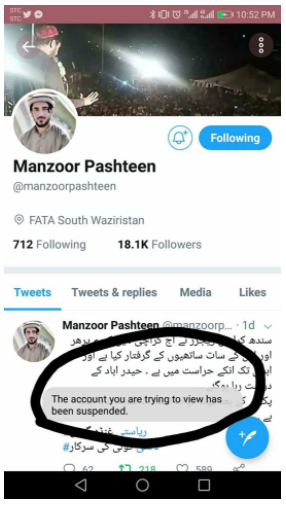
Source: Content Moderation Case Study: Twitter Removes Account Of Human Rights Activist (2018) | Techdirt

Manzoor Ahmed Pashteen is a human rights activist in Pakistan, calling attention to unfair treatment of the Pashtun ethnic group, of which he is a member. In 2018, days after he led a rally in support of the Pashtun people in front of the Mochi Gate in Lahore, his Twitter account was suspended.

Decisions to be made by Twitter:

  • How do you distinguish human rights activists organizing protests from users trying to foment violence?
  • How do you weigh reports from governments against activists who criticize the governments making the reports?
  • How responsive should you be to users calling out suspensions they feel were unfair or mistaken?

We’re constantly being told that Section 230 of the Communications Decency Act is the one, gold standard by which all speech on the internet is “allowed,” and how we can’t ever touch it. It says that companies cannot be held liable for the things that people post to their platforms. So why are Facebook and Twitter bothering to pick and choose what people can say at all? They are legally shielded from any problems. Just let people say whatever they way to say! If it turns out to be illegal, or slanderous, the people who posted those things can be sued by the affected parties. If people don’t like what’s being said, they be ignored and routed around.

I find the whole thing completely disingenuous. Either you have protection, and are for “free speech,” or you don’t, and need to police your platforms. Facebook and Twitter are acting like they need to kick people off their platforms to avoid being sued, but they are not at risk of that. They’re throwing people off their platforms because enough people make noise about them. It’s become a popularity contest, and mob rule. There’s nothing genuine, legally-binding, or ethical about it. That’s it. If some topic or person becomes untenable, they’re going to get the boot.

In the old days, the mob would boycott advertisers, like, say, the ones on Rush Limbaugh’s show. But you can’t do that on a platform like Facebook or Twitter, which use giant, shadowy advertising exchanges and closely-guarded algorithms to show ads to people, and everyone gets a different view, according to their profile. Even the advertisers have a hard time knowing how their ads are served or working! The people who would protest an advertiser would never know what is showing up most often on people’s pages whom they don’t like, and Facebook and Twitter sure isn’t going to tell them. That’s the secret sauce, baby. They can’t know who to go after.

So these platforms are proactively de-platforming people, but I can’t see why. They have legal protection. They can’t be blackmailed by boycotts of advertisers. What’s the mechanism here? What’s the feedback loop? I suspect the answer would make me even more cynical than I already am.

Posted in Technology | Tagged , , , | Leave a comment

Alex Kearns died thinking he owed hundreds of thousands for stock market losses on Robinhood. His parents have sued over his suicide.

In the wrongful death suit, Alex Kearns’ parents accuse the company of targeting unsophisticated traders like their son.

Robinhood had no customer service phone number, but Alex emailed its support address three times late that night and the following morning. He asked for help understanding what had happened, and whether he could still offset the losses with another trade.

Source: Alex Kearns died thinking he owed hundreds of thousands for stock market losses on Robinhood. His parents have sued over his suicide.

“Apps” and the black-box “algorithms” controlling them have their hands on most of the significant levers in our society now, and the companies that own them get to hide behind their “terms of service” which automatically absolves them of any legal culpability, and prevents them from being sued. And none of them have human beings to actually talk to when something catastrophic happens. (You know, like watching your wife’s Gmail account get hacked in real time, and having over 10 years of personal and financial email fall into some random douchebag’s hands.) Alex’s parents didn’t click through their ToS, though, and can’t be considered to have agreed to whatever “binding arbitration” clause they might have buried in them.

At the end of the day, though, there’s no way the courts will find Robinhood in any way responsible for Alex’s suicide. I mean, if they did, what would be next? Actually holding companies responsible for oil spills or chemical dumps, instead of fining them for what amounts to a rounding error of their revenues? Piercing the corporate veil, and jailing executives? Obviously, you can’t mess with the people paying for your election, so, ha ha, no.

Posted in Technology | Tagged , , | Leave a comment

GameStop: Cruz, Ocasio-Cortez Blast Robinhood over Trade Freeze

Robinhood was not the only broker to limit sales of GameStop. Interactive Brokers on Wednesday said it had placed restrictions on sales of the stock. Charles Schwab said Thursday that its customers could still trade GameStop but noted that it limited certain kinds of transactions involving more risk.

Source: GameStop: Cruz, Ocasio-Cortez blast Robinhood over trade freeze

I am gobsmacked about this whole story. Why did Charles Schwab “limit certain kinds of transactions involving more risk?” I mean, we all understand that what Robinhood is doing is simply unethical. They’re being manipulated behind the scenes by their big-bank investors. At first, Robinhood said they were just going to require enough in a margin account to cover loses. Fine; that’s fair. But Schwab? What trading platform has the balls to say “that trade is ‘too risky’ for us to allow you to make it?” The nerve.

This factors straight into all the posts I’ve been making about monopolistic platforms. All these giant new age apps, from Facebook and Twitter, down to trading apps like Robinhood and Charles Schwab, purport to be these egalitarian, equal-opportunity platforms, but, as we’ve seen over the past few weeks, they can simply choose to do whatever they want, exactly when people were relying on them to be open and available to them.

Don’t lecture me about how important Twitter was to the “Arab Spring.” First of all, that collapsed, and almost every one of those middle eastern countries in worse shape than before. Second of all, the minute the “other side” became troublesome here in the States, they got the boot. These platforms are not impartial. They’re king makers. And other platforms have watched Twitter and Facebook get away with picking winners and losers in the game of Free Speech, while hiding behind their terms of service, and they are naturally emboldened to do whatever they want too.

And don’t kid yourself, ever TOS you’ve clicked through is legalese for “we can do whatever we want with all of your stuff on our platform, and you have no legal recourse about it if you don’t like it.”

Don’t lecture me about how they’re not monopolies, either. First of all, once a platform like Twitter decides you’re done, everyone else colludes and follows suit. They are de facto monopolies, if not in fact. You have no credible alternatives. Second of all, they’re pulling the rug right out from under you precisely when you need it most. There’s no time to reorganize on another platform. By the time you do, the opportunity will be lost.

These past few weeks have really shown where we’re at as a society. We’re totally dependent on apps now, and they’re all under the control of the wealthy, not even government. This is deeply, deeply wrong.

Posted in Technology | Tagged , , | Leave a comment

The One Where All My Monitor Audio Dies

I’m moving my office back to the basement, and taking the opportunity to thin-out my collection of “stuff.” In the process, I’ve thrown out 2 bags of old computer parts, and I’m going to pitch at least one old computer. As part of the process, I’m wiping 4 hard drives before I chuck them in the bin, as I don’t know what’s on them. To do this, I hooked up the old PC which I used to abuse myself with ESO, and started to wipe one of them.

Then something happened to my audio. None of the audio in my monitor works any more, and my headphone amplifier — which had displayed intermittent problems before — now has a permanent, horrible ground noise. It’s like there was an electrical surge through the HDMI audio channel that blew up the monitor’s audio circuit, and then skipped over my analog mixer, and finally killed my headphone amp, which has been making ground noise intermittently for quite a while now.

Even with all I understand about engineering, electricity, audio, and computers, none of that makes sense. First, I wouldn’t think it would be possible to overload an audio channel’s circuitry over HDMI. There just has to be some sort of grounding to prevent this. Secondly, even if it did pass enough current to fry the amplifier circuit in my monitor, surely it couldn’t have hopped through the output, over the analog mixer, and then (finish) frying the (dubious) headphone amplifier.

After my decidedly un-Christian tirade that followed trying to sort out what was working and what wasn’t, I went looking again for the current news about the forthcoming, HDMI 2.1 Asus ROG PG32UQ. According to the Verge, when it debuts in Q2 2021, we should expect an MSRP of around $900. That’s pretty salty, but I’m ready.
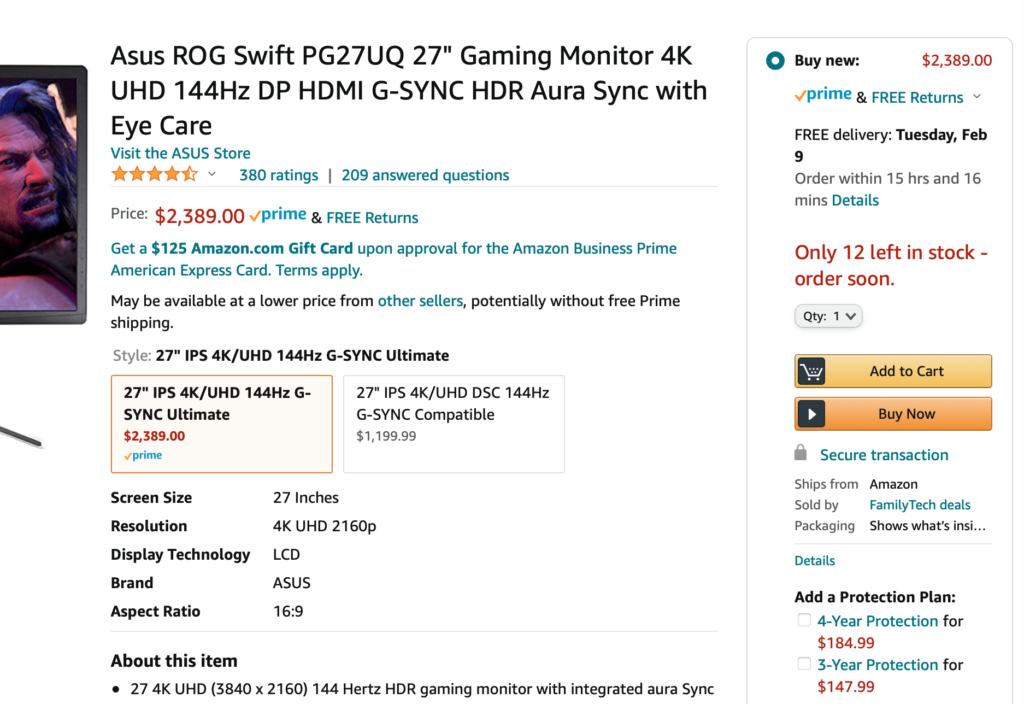
Asus is selling their 27″ version of the ROG Swift line on Amazon for $2,400! Or $1,200, but I can’t tell the difference between the PG27UQ and the XG27UQ, which literally doubles the price. Both of these choices are significantly more than the Verge’s estimation that the 32″ will cost $900, which is scary.

What’s really fascinating here is that the Verge reports that Acer has just released the Nitro XV28, which supports HDMI 2.1, but Amazon doesn’t have a single listing for that model number. According to Acer’s press release about the Nitro, they aren’t shipping until May. There are 3 models in the family, at $900, $1,100, and $1,200 price points, but there’s no real indication on that page what the differences in price are getting you.

What in the world is going on with monitors these days? I can go to Sam’s Club, and take home a 70″ 4K TV for, like $500! I don’t understand what the extra money is buying me. The widely varying prices on monitors seem to be due to the HDR part of the specs. Getting a good implementation seems to be eye-wateringly expensive. All seem to support HDR 400, which everyone seems to agree is basically like not having it at all. Given that I’ve never had it for 25 years of gaming, it seems like I can live without it until it becomes sanely affordable.

I don’t understand what’s so hard and confusing about this, and it’s precisely why I’ve gotten away from PC gaming. The same sort of relief I felt in moving from Gentoo Linux to Ubuntu, and then experienced again in moving from Linux to macOS, is what I’ve felt in moving to using a console for gaming. It’s just SO much less hassle. Up till now, I haven’t had to spend time educating myself on niggling details between unnecessarily-similarly-named models.

I’m going to try to hold out for a 32″ model of some kind, but if Amazon is correct, and the ROG 27″ is $2,400, only God knows how much it will cost. It’s clear that 27″ is a sweet spot in LCD manufacturing. I may have to give in on that. In any case, it looks like I’m going to have to wait 3 or 4 months to finally figure this out. Again, I don’t understand that. The monitor manufacturers have known about the next-gen console specs for years. You would think that they would have been more on top of this, instead of waiting 6 months after their launch.

Posted in Gaming | Tagged , | Leave a comment

A Little Chaos for a Treat – Pirate Wires

Do certain important people, defined here as people some subset of journalists find compelling, owe the professional media class a seat at their table? The question is interesting. Politicians and business leaders were once forced to travel through the establishment media’s gateway to reach the masses, and as I’ve been writing for months social media influence at scale does pose unique and concerning challenges to society. Our world is different, now, and different doesn’t necessarily mean better. But no one ever engaged with the media because the media was especially moral, or True. People engaged with the media to reach the media’s audience. As an audience is no longer unique to the media, we are left with innate media goodness as a defense of a media discourse monopoly, which strikes me as… less than persuasive.

Source: A Little Chaos for a Treat – Pirate Wires (emphasis mine)

This guy is talking about the role of the media in a world where “the media” has become defined as “Twitter.” He’s correct, of course. Dominant people on Twitter don’t need the blue checkmark journalist class to reach their audience. They can do an end-run around their narrative-shaping opinion-making barricades. But, if you look closely, you might notice that this argument has reduced to: wealthy people don’t need the media to transmit their message any more. The allegedly egalitarian and supposedly unprejudiced modern social media platforms have simply become the direct line for billionaires to communicate directly to the public. They have become tools for the billionaire class, who, by nature of the inherent influence commensurate with their wealth, have the name recognition to bypass the platform’s gatekeepers. I don’t know what “the media” will look like in 5 or 10 years either, but traditional media’s future looks increasingly bleak, and they can thank the platform that they based their hope on 15 years ago.


Posted in Technology | Tagged , | Leave a comment

Discord bans the r/WallStreetBets server – The Verge

Discord says it did not ban the server for financial fraud — rather, it was banned because it continued to allow “hateful and discriminatory content after repeated warnings.” The Verge gained access to the server and can confirm the claim that users of the channel were spamming hateful language, including racial slurs.

Source: Discord bans the r/WallStreetBets server – The Verge

Other shoes are dropping on the GameStop Stock Reddit Bubble. Discord deplatformed /r/wsb because of “hate speech.” A mod of /r/wsb says it was one bad actor fuzzing the language filters on the channel with unicode, and one message was all it took to trigger the ban. That sounds about right.

Then the /r/wsb mods took the sub private for an hour. What was that all about?

Like I said in my previous post, the market is a zero-sum game (in that someone has to lose in order for someone else to win), and the hedge funds with strong short positions in GameStop are taking huge losses. I’d bet a steak dinner that the owners of Discord were getting pressure from (other) wealthy people to find an excuse to shut down /r/wsb’s “command and control” channel, which is organizing a massacre of their investments.

For all intents and purposes, Wall Street investment banks are a de facto branch of the government. I’m pretty certain that ruining some bank’s day with a crowdsourced market “hack” is going to attract the ire of the SEC, no matter how “technically legal” the people on /r/wsb say it is. All it’s going to take is one small flub, like with the Discord ban, for them to step in and start issuing subpoenas.

What I didn’t say in my previous post, I’ll say now. The market is rigged. There are lots of massive players, creating artificial moves, and basically printing money. Some of the most brilliant programmers and mathematicians work on Wall Street. They have some of the most impressive computers and networks on the planet. I read once that one bank, back in the day, installed fiber optics, at massive expense (at the time) from their office to the trading center to improve their latency by double-digit milliseconds. This was enough of an advantage in high-frequency trading that it sounded like they thought it was a no-brainer. These are the people the autists in /r/wsb are up against. People with unlimited resources of money and brains.

The only reason the market works, in general, is because there always has to be people joining the market. If the market looks obviously-gamed, people won’t play. The old adage about leaving your money in the system for 40 years, and collecting about 10% compounded interest has to continue to be true, or people will find something else to do with their money, and the whole thing will collapse like the pyramid scheme it actually is. It’s the biggest money-printing machine in the world, and it’s protected by the US government. You don’t have to look any further than the housing crisis to understand that the powers that be will not allow anything to hinder their ability to print money with the machine.

If /r/wsb expects to step out, and manufacture more chaos with other strongly-shorted companies, the people leading the charge are going to find themselves being investigated. Discord says they didn’t ban them for financial fraud. Of course not. They’re not in a position to pass judgement on whether that has occurred. No, they’ll leave that to the feds, and I expect this is already being organized as I write this.

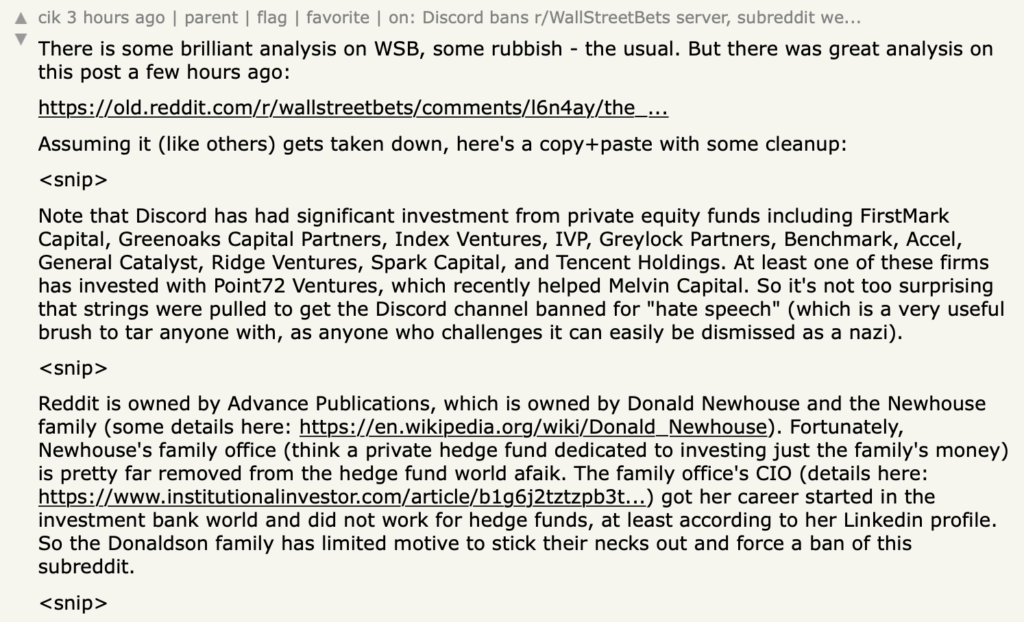
UPDATE: Reading the HN thread about the article, I find this comment, and I’ll repost his repost:

So I was spot on. There’s duplicitousness at work here. Discord is simply doing a favor for the people being negatively affected by this farce.

I note, for the record, that if Section 230 were repealed, Discord would have shut them down for fear of being inculpated in possible financial fraud, as should have been the story.


Posted in Technology | Tagged , , | Leave a comment

Social justice groups warn Biden against throwing out Section 230 – The Verge

“Section 230 is a foundational law for free expression and human rights when it comes to digital speech,” the letter says. The law protects websites and apps from being sued over user-generated content — making it safer to operate social networks, comment sections, or hosting services. “Overly broad changes to Section 230 could disproportionately harm and silence marginalized people, whose voices have been historically ignored by mainstream press outlets.”

Source: Social justice groups warn Biden against throwing out Section 230 – The Verge

First of all, no it isn’t. It’s a “foundational” law protecting corporations and their precious profits. Don’t pretend that it’s about anything other than the almighty dollar, and Capitalism. Any benefit to people and free speech is accidental. In fact, I recently read that many people argued exactly the opposite of this when it was being debated.

You can only be sued (credibly) for saying something illegal. Why should removing section 230 “disproportionally harm and silence marginalized people?” Are marginalized people more prone to saying illegal things? If so, is that why they’re being marginalized?

Do the people writing this accept that the most-prominent example of people being marginalized, cancelled, and deplatformed are QAnon right-wing nut jobs? Are they advocating that they should NOT be banned on social media platforms? Are they standing up for their rights? No, of course not. We all know this kind of language, and what terms it’s being used as a proxy for.

As I’ve been saying, I want Section 230 revoked. You can play what-ifs about this all day long, but we, as a society, need social media platforms to be accountable — under threat of a lawsuit — for the things they allow on their services. They’d get serious about throwing the child porn and direct threats of violence off their sites in a New York minute.

Will they have to hire more people to do it? No, not even that. They’d have to buy a bunch more servers, and run them to block that junk. I have people tell me all the time that this is beyond current computer science. Bologna. If YouTube and Facebook can scan all uploads in real time for any copyrighted music, social networks can scan for nudes and threatening language in realtime, and at least winnow down the posts that need further review. They’d have to spend a bunch of money on servers instead of throwing a pittance at a bunch of contractors in impoverished nations. Cry me a river. Spend some of those billions you’re making a year already.

Worry that it will affect you? Don’t say or post anything illegal. It’s that simple. What’s illegal? That’s up to the government, not Zuckerberg or Dorsey, or the boards of Facebook or Twitter.

I have literally no sympathy on this point. We’ve tried the internet for 25 years with Section 230, and Facebook and Twitter are literal existential threats to society which have been allowed to develop. Let’s get rid of it, make corporations finally take responsibility for these monsters they’ve created, be accountable for their algorithms and funding sources, spend some of their hoarded blood money, and just see what happens. I find it impossible to believe that this could make the situation any worse for society.

Posted in Technology | Tagged , , | 1 Comment

Dopamine Thirst Trap – Pirate Wires

As with almost everything on the internet, misleading headlines are not a new phenomenon. What’s new, and notable, is the scale of our exposure to the phenomenon. Today, on Twitter, many of us now spend a significant portion of our lives inside a virtual world of headlines.

Source: Dopamine Thirst Trap – Pirate Wires

Well, not me. I deactivated my Twitter account again. I can’t, in good conscience, continue to be manipulated by the platform. That being said, I’ve been fighting the urge to reactivate it, because I enjoy the thrill of seeing all the drama unfold in real time. That’s the problem, and why “the only winning move is not to play.”

This guy points out that Twitter’s censorship has not been fair, so they’re going to crowdsource it, and then, rightly, makes fun of the idea:

Anyway, Twitter said “fuck it” this week and decided they could crowd source the truth.

I publicly critiqued Birdwatch for what I believed the obvious danger inherent of determining “truth” by popular vote. Like, from science to civil rights literally when has this ever worked out? A handful of commenters expressed frustration with the point, and asked what I would do about the problem of misinformation were I in charge. But misinformation is as old as human civilization. What’s new is the phenomenon of instantaneous information virality, and this is where we should focus.

Where does someone go to defend themselves from cancellation if hosting providers follow suit, and won’t let them back on the internet? You can say that Parler had other alternatives besides AWS to host their site, but I venture to say, given prevailing public sentiment, that Microsoft and Oracle wouldn’t have let them use their clouds either, for fear of being labeled “Nazi sympathizers.”

You can say — as I have — that they could buy some servers and rent space in a co-lo facility, but who’s to say that public pressure wouldn’t cause the hosting company to give them boot, or their ISP’s to cut off network access, or their WAN providers to remove their BGP routes, or their DNS registrar to delete their entries? We are all dependent on access to the internet at this point, and there are many gatekeepers involved. The mob can apply pressure at any one of these points.

My approach to the news has been to read alternating reports about controversial stories until they “converge” on a consistent set of most-likely facts. Not coincidentally, I cribbed this approach from how I go about implementing a new programming technique. I read a lot of documentation, Q&A’s, and blog posts about it, until I see a consistent, reliable, and understandable implementation emerge. How will I be able to read original sources and make my own informed opinion about some of the most important, yet controversial, issues of the day, when platforms acting as de facto common carriers eject people from their services when the mob gangs up on them?

Either we’re a county that believes in freedom of speech, or we’re not. You can say that we shouldn’t allow speech calling for violence. We don’t. There are all sorts of legal remedies for this already. You can say that the speed by which this particular form of speech makes it impossible to react quickly enough to avail ourselves of our existing legal tools. That’s why “Pirate Wires” here is advocating slowing everything on Twitter down, and admitting up front that this idea runs in stark contrast to all the profit motives driving the company.

I think banning people you don’t like because they said something which might be legally actionable is the wrong approach. For every single example you can show me where some “conservative” said something legally objectionable, you can find some “liberal” who said exactly the same thing. The “liberals” I’ve traded comments with about this say “it’s not the same thing” because you have to consider the size of the audience of followers. Fine. Put that into the algorithm then, and then do it. It’s just popular, right now, to go after the conservatives. What happens when the same rules get applied to the next big Antifa or BLM protest, and “leaders” of those movements suddenly find themselves without the platform on which they’ve relied? I suspect we’re going to find out, and pretty quickly.

Posted in Technology | Tagged , , | Leave a comment