Dead Reckoning • Damn Interesting

During one such inspection in 1731, a British merchant captain named Robert Jenkins protested the intrusion, and in the ensuing scuffle the Spanish captain’s blade somehow separated Captain Jenkins from his left ear. This civilian injury was far from newsworthy back in Britain⁠—after all, smuggling was a rough business. Eight years later, however, when Great Britain sought a pretext for war, it became politically expedient for British politicians to suffer outrage over this unauthorized amputation. Legend has it that Captain Robert Jenkins himself held aloft the very ear in question at a Parliamentary hearing, as evidence for the grave insult to the crown⁠—though there is no historical proof that this exhibition actually occurred. Ear regardless, the outrage was successfully fabricated, and the resulting years of hostilities would come to be known as “The War of Jenkins’ Ear.”

Source: Dead Reckoning • Damn Interesting

Emphasis mine, and that may be the best turn of English I’ve ever read.

Posted in Humor | Tagged | Leave a comment

Book Review: From Oversight To Overkill

This article from Astral Codex Ten is making rounds in my Twitter feed. It describes the lack of progress in society to the avoidance of — not just dangerous issues, or most danger issues — but all danger. That is, any danger that can possibly be quantified, lest lawyers get involved and sue.

I’ll go a step further. It’s probably not even important when or if lawsuits might happen. Rather, the really important thing to be avoided is the potential loss of face and embarrassment for not covering enough exposed buttocks to prevent it in the first place. More to the point: for not making every liability someone else’s problem.

When I worked in a psych ward, we used to use a short questionnaire to screen for bipolar disorder. I suspected the questionnaire didn’t work, and wanted to record how often the questionnaire’s opinion matched that of expert doctors. This didn’t require doing anything different – it just required keeping records of what we were already doing. “Of people who the questionnaire said had bipolar, 25%/50%/whatever later got full bipolar diagnoses” – that kind of thing. But because we were recording data, it qualified as a study; because it qualified as a study, we needed to go through the IRB. After about fifty hours of training, paperwork, and back and forth arguments – including one where the IRB demanded patients sign consent forms in pen (not pencil) but the psychiatric ward would only allow patients to have pencils (not pens) – what had originally been intended as a quick note-taking exercise had expanded into an additional part-time job for a team of ~4 doctors. We made a tiny bit of progress over a few months before the IRB decided to re-evaluate all projects including ours and told us to change twenty-seven things, including re-litigating the pen vs. pencil issue (they also told us that our project was unusually good; most got >27 demands). Our team of four doctors considered the hundreds of hours it would take to document compliance and agreed to give up. As far as I know that hospital is still using the same bipolar questionnaire. They still don’t know if it works.

Source: Book Review: From Oversight To Overkill

What I see here applies to IT departments in bluechip Fortune 250’s as well, and it makes working within them glacial. A half dozen different departments have to weigh in on every single project, no matter how large or small, and give their blessing on each aspect of the infrastructure. Every one of them has the institutional power to say, “Stop. We need to add X, Y, and Z to your project for ‘safety,'” and no one can say, “No, this is an acceptable risk for the data involved, the architecture of solution, and the benefit we can get from implementing it.”

I’ve watched this CYA-above-all-else attitude grow in society over the course of my career. All the way back in the early 90’s, even before Outlook, Microsoft implemented workflows in their email client. Someone at my company setup an automation to get capex proposals approved. There was a long-standing paper process that determined “how high” up the “food chain” a request had to go based on the value of the proposal. With the new system, you would write an email, select your department, give it the value of the proposal, and this automation would route it through the right chain of people for you. You could just sit back and wait for the green light to write the purchase order. Great, right?

Wrong.

Nothing moved through the system. Turns out, managers wouldn’t read the email. Approving that button meant a hard-and-fast commitment to put their name on something, and they all needed at least to have a conversation they could say they misunderstood or were lied to about, so the email would just sit. You’d have to go hunt them down, have that conversation, and then they’d hit the “approve” button in the email, and it would move to the next person in the chain. And then you’d have to go hunt them down, and repeat the process.

I asked a wise friend why this didn’t work as planned, and he pointed out that it took getting through a dozen people who could say “no,” when none of them could say, “yes,” and just be done with it. It was a light-bulb moment that has stuck with me ever since. It was the first time I would see an information system — not just support — but codify risk aversion in a company, but it surely wasn’t the last. Now the process of identifying risk and implementing a bunch of needless overhead to avoid it has become institutionalized, especially in IT.

Entire departments are separated by job function in a useless nod to the idea of “separation of duties” which external consultants tell upper management is required in IT departments. The problem is that none of these departments ever have enough operating knowledge about what the work they’re doing on behalf of other people, and just do what’s been requested. There’s no actual responsibility for that separation of duties; no understanding of what’s being asked in context. So no malfeasance would be prevented by it, making the whole thing a dog-and-pony show and a waste of time that slows down every single project in the company. No matter how small or focused a project might be, everyone in the organization has to get involved as if any problem or weakness in the effort would literally destroy the company. The bottom line is the process offers no improvement in delivered projects, but it makes them take at least an order of magnitude longer than they need to. 

Posted in Technology | Tagged , | Leave a comment

To ESO or Not to ESO

Back at the first of the year, I “retired” from the Elder Scrolls Online. I let my ESO+ subscription lapse, and simply stopped playing. There were many reasons.

First, I really felt like the game was dying. The monthly user counts were as low as they had been in 7 years. People were complaining about the changes in the game in on their forums and on Reddit. There were many performance problems, crashes, and disconnects. There was a 9-month ongoing thread on their forums about it. Even if you weren’t affected (I wasn’t), you couldn’t play through a whole trial without several people dropping, and having to wait for them to rejoin. This was causing trial prog groups to give up, because you couldn’t satisfy the time requirement part of the trifecta. Also, ZOS canceled the American half of their big 10 year anniversary tour, after having had the one in Amsterdam, and they were being jerks about how streamers were covering them. Even though it came out a few weeks after I quit, the collective atmosphere around the game was such that the most prominent ESO streamer, NefasQS, quit as well, and made a whole video about why.

Second, running vet trials was pretty stressful. Thanks to the Oakensoul ring (for heavy attack builds) and the Arcanist class, I was able to put characters together to run vet content, and farm endgame gear. I got all geared up on 2 DPS characters, a tank, and a healer. But vet trials are 2 hours of sustained clicking, with very little break. I felt that it was hurting my health. It’s far too much to get into here, but I feel that part of my health problems stem from holding stress in my gut, and I started to realize that I was clenched and barely breathing for most of those 2 hours. Vet trials require everyone to be paying attention, or you will wipe the group. It also requires all the DPS you can manage, all the time, or you will wipe the group. And, most of the time, when the group wipes, you know who caused it. So there’s a lot of pressure to perform, and there’s a surprising amount of skill involved in playing the game at that level.

Third, I was running with a casual guild a couple times a week, and it felt like I wasn’t really clicking with the leader. One evening, I volunteered for a 4-man dungeon that the leader wanted to run, and even though I was vocal about wanting to run the dungeon, she ignored me and chose someone else to run who chimed in well after I did. It hurt my feelings. It was done in a way with plausible deniability, as only people who spend a lot of time on Discord can appreciate, but I had enough history to contextualize it, and I just couldn’t not see it as personal. She just didn’t want me to run with her. I mean, everyone is allowed to do what they want, but if I’m honest, it hurt my feelings quite a bit. Also, the guild leader had allowed another guild to merge with hers, and I didn’t really care for the people who had joined. Altogether, it was just another piece of the puzzle that was deflating my interest in playing.

Fourth, I had managed to knock out most of the achievements in the game, except the PVP stuff. The only major areas I had left to do were running the Infinite Archive and playing Tales of Tribute. IA is pure ESO combat, and I think ESO’s combat is the least likable thing about the game. And ToT is a card game. I didn’t start playing an MMORPG to play a digital form of Dominion. I hate any game that you can spend a bunch of time working on, and then lose suddenly. I didn’t want to do either of those things, so what was left?

So I quit.

I also retired from Fallout 76 at the same time, for the health reason. The FOMO about needing to log in every day and do the things that get you the rewards was anxiety inducing.

But then after several weeks, I got bored, and started playing 76 again.

Then 76 released a fantastic update that I have been loving.

And now ESO has announced an update which sounds like it will also be awesome.

So now I’m considering picking up ESO again, and the question is: To ESO or not to ESO?

First, I like the depth of the game. While I love the combat in 76, it’s very shallow. You can do everything there is to do in a day in the game in about an hour. That’s more like 3 hours in ESO, and that’s just one character. In ESO, you can have 20, while 76 is limited to 5. 76’s main quests will take at most a couple weeks to do. ESO’s takes at least months, if not years. There’s just a lot more to do in ESO.

Second, I like the look of the game. 76’s runs poorly on the PS5. The textures are mushy, the draw distance is clipped, and it rarely feels smooth. And it crashes. A lot. I mean, a lot. ESO runs flawlessly at 4K@60FPS in ultra mode on my modest PC, and it’s beautiful.

Third, I miss doing group content with real humans playing mechanics. I’ve become friends with many people in 76 through doing its one raid, but that’s really just cheesing the first (and maybe last) stage, and there’s really not much to talk about. So most of the time, people are just blathering on about nothing in comms, and I have nothing to add. ESO’s trials require comms, and talking about what’s going on, in order to get through them. I guess it’s all pretty impersonal, but on console, in 76, it’s REALLY impersonal. At least in ESO, there’s more camaraderie, and longer times in doing the content lead to closer relationships than in 76.

Fourth, this new update will make it easier to do damage, which will make all content easier. So trials should be less stressful, and Infinite Archive should be less tedious and grindy.

Unfortunately, that still leaves the “problem” of Tales of Tribute, and the fact that they “hid” a mythic lead behind doing it.

There’s also the issue of PVP. I’ve tried serious PVP with one of the big PVP guilds, and it was interesting. We were always getting beat, but I would do more if the game engine was more fair. Mechanically, PVP is in terrible shape in this game. It leads to nothing but gimmicks. I know — and ZOS knows — what the problem is, and they’re going to have to make a lot of people very mad to fix it, so the future is not great. Additionally, socially, the pressure brings out even more cringey behavior in guild comms, and there’s probably nothing to be done about that. So PVP is a negative regardless.

I don’t know what the answer is. At least, not yet.

Posted in Gaming | Tagged , | 1 Comment

People Trapped by Their Decisions

This is an eye-opening take on a heartbreaking situation. The woman being interviewed in this video is fighting against the incursion of biological men in women’s spaces. She describes the people who are fighting against her have motivations they are not being honest about. While not public knowledge, they have transitioned their children, so they have to fight for “trans rights” until the day they die. She says she has become a “standing reproach” to these people, and likens them to the Japanese soldiers in WWII who would never surrender after the war was over. They are forever compelled to attack her, because to agree that she makes a good point — any point — would mean they were wrong, and lest they have to face the fact that they have done irreparable damage to the very ones they had responsibility to protect from such abuse.

I’m not here to get into any of that argument. I simply realized it has a wider application.

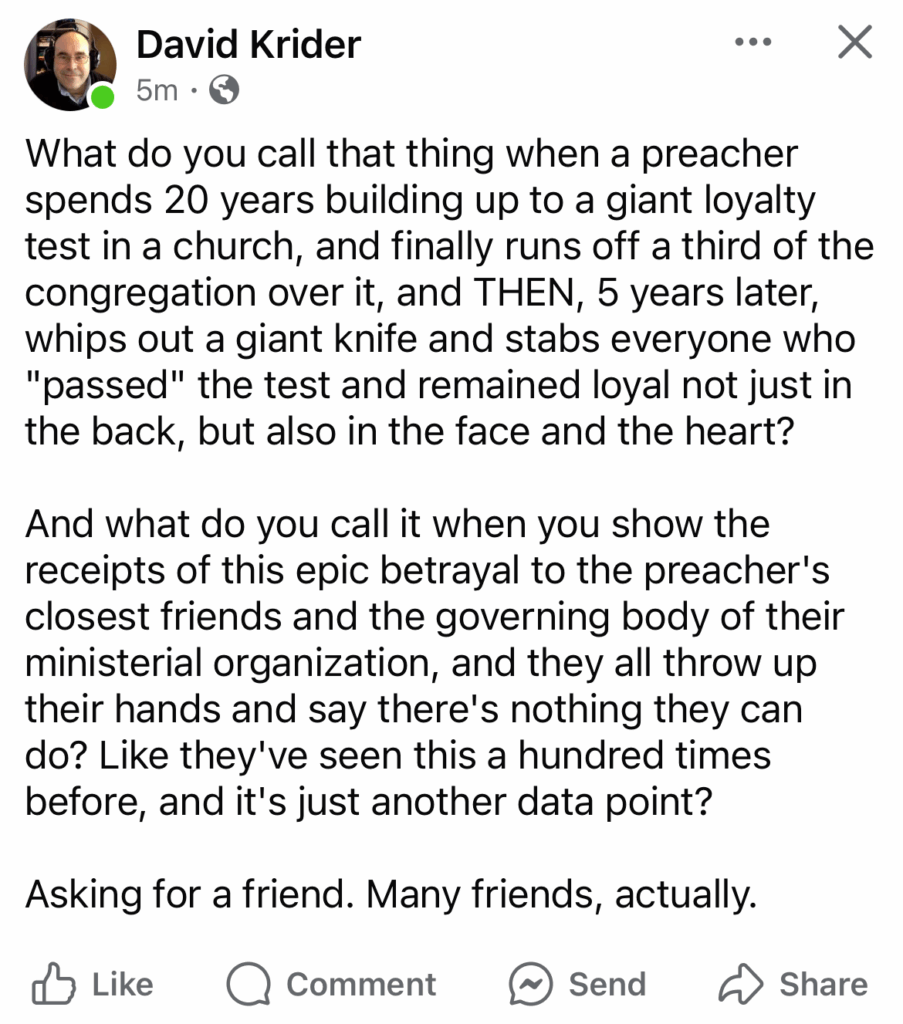
This was my last post to Facebook, before I deleted my account.

I can’t get into details… at least not yet… but imagine, for a second, the length, breadth, and depth of the betrayal that would lead someone to make such a post. That might be captured by the image of being stabbed in the back, face, and heart. Got it? OK.

Now imagine the “support” system that has to be in place for someone to have implemented such a betrayal, not just of a person or a family, but an entire mid-sized church. The friends and family that had to have colluded. Got it? OK.

The people who played a part in committing this betrayal are still going around telling people that they were falsely accused, that there’s “another side” to the story, lying about that “side,” and blaming the entire problem on others (including me, I’m sure), despite the fact that scores of us who know the details about what happened are crystal clear about it. We have the figurative and literal receipts proving “our” side. I helped dig them up. Over the past couple of years, I’ve often agonized over the question, “How can they be like this?”

That’s where the video comes in. When I watched it, it was an aha! moment. I finally realized that the people who worked to enable this giant betrayal, this… gargantuan rug-pull, this… 40-year-long con will never — can never — admit to any wrongdoing or their part in it. The soul-crushing disappointment of facing the reality of being such a narcissistic sociopath would be too much. So they are going to go to their grave sticking their fingers in their ears and yelling, ignoring the plain facts of the situation, and avoiding their own consciousnesses over their multiple, decades-long moral and ethical failings

They have to live in a headspace where they say things like I’m “misinformed,” because if I’m not, it has soul-crushing implications. They’ll live the rest of their lives in an ivory tower of their own imaginations, locked away from the generational spiritual and emotional harm they’ve inflicted on hundreds of people, including some of their closest, so-called friends, because to admit they’ve committed such grievous injury would be impossible to reconcile with their their supposed beliefs and ethos, and their carefully-curated public image.

Posted in Personal | Tagged | 1 Comment

Bethesda’s Roadmap

I found this 10-month-old interview with Todd Howard, the president of Bethesda. As usual, there’s a lot of talk, but little of substance. Look, I get it. Given his position, he can’t be very specific, or gamers will hound him until his dying day about something he said that didn’t work out the way they wanted. But if you listen between the lines, he says something that lines up with where I think this is all going.

Given my previous and salty experience of buying the advance-availability digital deluxe version of Starfield, and then refunding it because of the nightmarish inventory management, I just went and looked at the Steam chart for Starfield.

Ouch. That seems low. So I went and looked at Skyrim too, for comparison.

Like, ouch, man. The 12-year-old Skyrim has almost ten times as many players as Starfield. Maybe this is an unfair comparison, as Skyrim has twice as many players than Elder Scrolls Online and three times as many as Fallout 76, so Skyrim is sort of a juggernaut of video games. But still. Dang.

I found another video (which I won’t bother linking), lamenting the lack of updates to Starfield since launch while the player numbers languish. He complains that the potential of the game isn’t being realized. However, the “potential” of this game is being worked on, just not in the way he’s looking for it.

When Fallout 4 released, the settlement building aspect was widely criticized as not making much sense in the context of a single-player game. You could build up all the settlements in the game, and create supply routes between them, so that you could pool all your building materials together, and then… the people of those settlements would… help you fight random encounters all over the map? Really? All those hours of effort for this benefit? It was a really good subsystem, but that was the weird part. It made you question why a great, in-game building tool had such an obviously significant development effort put into it, when the in-game utilization of it was so weak. When they eventually released Fallout 76 on the same engine, it suddenly made perfect sense.

Well, they’re doing the same thing with Starfield. It’s well understood through some online leaks of recruiting posts that the studio is working on another “untitled” MMORPG, but it seems patently obvious (at least to me, given previous history) that this will be based on Starfield. So the lack of updates with Starfield has to be understood in this context.

They are surely coordinating the direction of the inevitable single player game expansions with the work going on with the MMO version of the game. In the same way that they timed the big Fallout 76 Ghoulification update to land with the TV show, I believe they’re holding things back waiting on other teams. Don’t forget that they promised to port it to Playstation, and now people are noting that this is being hinted in the Creation store, so that’s coming, and what better way to hype that re-launch on a new platform than with the forthcoming Shattered Worlds update? And after that, the next big update will probably land with the reveal of their new MMO based on the property.

Posted in Gaming | Tagged , , , | Leave a comment

That’s Just… Too Many Buttons

Reminds me of the joke where the guy says he went in to work early, and switched the N and M keys on half the keyboards, claiming, “Some people will call me a monster, but others will call me a ‘nomster’.”

Posted in Humor | Tagged | Leave a comment

The Inevitable Monetization of Subclassing

The well-known Elder Scrolls Online streamer, Alcast, has a writeup about the forthcoming ESO subclassing feature here: https://alcasthq.com/eso-how-to-prepare-for-subclassing/. He points out that you have to level a skill line to 50 on a class in order to unlock it for use in subclassing, then you have to re-level it to 50 as a subclass line, at half the normal rate of advancement. However, at least that subclass skill line is shared among your other characters.

When they announced this feature was going to be free for base game, I was surprised. Given previous history, I expected this to cost 1500 or 2000 Crowns per character. Now the monetization angle becomes clear. I think they’ll offer instant subclass skill leveling in the Crown store, and the only question becomes will it be 1500 or 2000 Crowns, and will that be for all 3 skill lines as a class, or per individual skill line? My first guess was going to be 1500 per skill line, but on further reflection, I think it will probably be 3000.

Now we wait to see…

UPDATE: The new patch landed, and they did not offer a way to insta-level subclass skill lines. So I was wrong, and it’s too bad. I think they would have gotten a lot of money out of me. I spent several hours grinding the hard way, realized that I was having zero fun, and quit for good.

Posted in Gaming | Tagged | Leave a comment

No Comment

I have laughed until my stomach hurts. I needed this very, very badly.

Posted in Humor | Tagged | Leave a comment

Everything in Every App

Poly Lens

This is a real screenshot of an app that starts automatically on my work laptop at login. It’s part of a driver for Polycom headsets. I don’t have a headset plugged in, because my kid’s pet rabbit chewed through the cord too close to the ear cup, and I couldn’t fix it. Regardless, this is still running, popping up like it’s important, and has such necessary and tightly-coupled-with-headset activities as showing me “insights” on my computer’s “connectivity,” reminding me to hydrate and rest, and teaching me about ergonomics. Thank goodness my (former) headset manufacturer is looking out for me like this. I don’t know what I would have done otherwise. I might have gone all day without drinking a glass of water or something.

Posted in Aggravation | Tagged | Leave a comment

Neuro-Atypicalness

I follow Dave Plummer on YouTube. He’s one of the OG Windows programmers. A true hacker in the best traditions of the ethos. Turns out, he’s on the spectrum. He wrote about book about being out on “far end,” so to speak.

Can you be a “little bit” autistic?

He’s written enough about his neuro-atypicalness on Twitter to resonate with me, so I bought the book. The whole first part is explaining how things “work” for him, and I got tired of going, “Well, yeah,” and set it down.

I just picked it up again, and skipped ahead to the next part, and he hit me with this:

“Much of my life was spent presuming that, as an intelligent individual, my version of the world was the right one and that all I had to do was sufficiently educate, convince, and cajole the other person until they “got” my version.

Which is exactly what I was referring to in this post, where I was trying to convey how futile trying to persuade people has been for me over my lifetime. I’ll give an example.

One of my earliest memories of this type of conflict happened in the late 90’s. I was working for a bluechip Fortune 250 which no longer exists. It was a special place, and it was destroyed in a textbook corporate raid, but at the time, I had established myself as someone who knew what they were doing with computer systems, and — at least I like to believe — had the respect of the leaders of the various IT subsystems of the company.

The company was pretty big, but the IT staff was relatively small. By comparison, the company that bought and pillaged us was about the same size, but had an IT staff four or five times as large. We were having a big meeting with most the IT people, and the subject of DNS came up. I was frustrated that I couldn’t spin up hostnames in our DNS system, and had to ask and wait for someone to do it for me. Now, the person in charge of the network had had enough foresight to make various sub-domains based on sites. For instance, our technical center was ctc.arvin.com. So hosts could be given names like pdm.ctc.arvin.com.

I made the point that the local site IT admins could be given permissions to be able to create new names in their local subdomains. I was trying to get them to allow my own site’s admin to be able to do this for me, without needing to involve corporate, and wait. I remember pointing out that the system was designed to work this way, implying that it would be easier to let them do this themselves.

One of the big 3 IT bosses said that the local site admins wouldn’t be able to do that. I thought that was silly. After all, the DNS admin tool in Windows NT was really easy to use. My prototype and testing facility’s admin was one of the most talented IT guys I’ve ever met. Still. Thirty years later. So I was imagining that the rest of the site admins were at least competent “computer people,” which wasn’t the case. Like, at all. The other sites — the manufacturing sites — were having their IT needs met by someone who just got picked because they had an inkling of what was going on, and had the bandwidth to setup the box. A couple years later, I would be meeting some of them, and they turned out to be HR people and shipping clerks. I was confused by the disconnect in the moment, but I dropped it. But after I met some of these other people, I finally got it, and was able to fill in the gaps in that story. It was an honest clash of multiple levels of high-flying expectations dashed on the rocks of reality.

It took me a long time to see that my whole approach lead people to think that I thought they were stupid. In this particular case, I’m sure I made the managers in the room feel like I was calling the site admins incompetent. No, I just made bad assumptions, and gave people the benefit of the doubt. This is a very different thing, but people can’t see it that way when they feel they’re being indirectly accused of not being unqualified. If I had understood the proper context of the other sites, instead of extrapolating from the one I was familiar with, I wouldn’t have suggested it in the first place. But despite being a trained mechanical engineer — where every single problem I ever solved started with identifying my assumptions — I still sometimes can’t see that my assumptions are bad. It’s probably because I’m just rushing to get to the place I want to be.

Posted in Personal | Tagged | Leave a comment