

Mighty’s master plan to reignite the future of desktop computing

We’re excited to finally unveil Mighty, a faster browser that is entirely streamed from a powerful computer in the cloud. After 2 years of hard work, we’ve created something that’s indistinguishable from a Google Chrome that runs at 4K, 60 frames a second, takes no more than 500 MB of RAM, and often less than 30% CPU with 50+ tabs open. This is the first step in making a new kind of computer.

Source: Mighty’s master plan to reignite the future of desktop computing

What a joke. This is just a cagey attempt to track user ALL behavior across ALL sites, without even needing cookies or web bugs or other such hacks. Even Facebook can’t track you across sites that don’t load their script. I have Twitter blocked on my network, but the famous VC investor Paul Graham is apparently all about it. Given the completeness of the tracking information you could get from this, it’s no wonder. The potential upside here has probably made it trivial to get the money to run in stealth for 2 years on this thing.

User DaveV1.0 had a good comment on Slashdot:

The modern browser is wicked stressful on computers.

TL;DR: We are doing it wrong.

This is because:

  • Web pages are now the size of entire operating systems.
  • We are asking web browsers to everything an operating system does on top of an operating system.
  • We are using web browsers to do things that should be done with other applications.
  • We are using a stateless protocol to do tasks that require states.
  • We are doing things that require high security in an inherently insecure environment with an inherently insecure protocol requiring bolt-on extensions.

We are doing it wrong.

I mean, yeah, there actually is a use for “Mighty.” We’ve made HTTP do things that Tim Berners-Lee never even imagined in his wildest dreams, thanks to building a Javascript runtime interpreter into every browser, and downloading an entire application with each page of markup. Even in my current Rails app, where I use very little Javascript, webpacker warns me about the size of my current bundle: 249 KB. For comparison, the page is only 30 KB. Thank God for caching, I guess.

User Perseids on “Hacker News” asked the CEO of the company about issues of security and privacy:

I can’t help but ask: As a security conscious person, how can you justify creating the service? You’ll have the data and access of everything your customer does online, which for your target audience is everything your customer does on a computer. For the individual customer this is worse than Google, Facebook, Twitter combined. Also, you’ll have an effective backdoor into every two-factor authentication, be it online banking, valuable Twitter accounts or AWS admins. There are massive monetary and political incentives to hack or infiltrate your service. Given your scale, you can’t have comparable security measures to the big players. And given your location (US) you’ll eventually receive national security letters forcing you to secretly sip off anything secret services or law enforcement wants you to.

He didn’t respond.

People with M1-based Macs aren’t going to care about the performance of their browser. There is so much extra computing power in those things, they’re begging for something to do. Might as well be crunching media-heavy web sites. Maybe there’s some hope that poorly-ported video games will smooth out with the extra cycles…

Whatever. The joke’s on them, anyway. At $30-$50/mo, by the time “Mighty” could reach any sort of serious market penetration, users will interact with apps rather than web sites anyway. With an i9-based MBP, Imgur can make even my computer wheeze, but that’s because they load, like, 50 thumbnails on EVERY page view, and half the posts on the image sharing site are now video. Like Reddit’s execrable web site, I can only guess this is a move to push people to their app.

No, the next big shift is not to centrally-hosted web browsers. It’s to get rid of browsers entirely. Watch for one of the big sites, like Amazon, to introduce an “app” for their site, which will be based on Electron. Either that, or they’ll just go with Apple’s new thing where you can run their iOS app on macOS, and dust off their hands. (Poor Microsoft, with no mobile, and poor Google, with no (real) desktop!) Web sites for the places big enough to make apps will eventually just be a pointer to their app.
Posted in Technology | Tagged , | Leave a comment

Doorbell video captures police officer punching and throwing teen with autism to the ground – CBS News

A Ring doorbell captured footage of a police officer in Vacaville, California, throwing a 17-year-old to the ground and punching him in the face on Wednesday, according to the teen’s father.

Source: Doorbell video captures police officer punching and throwing teen with autism to the ground – CBS News

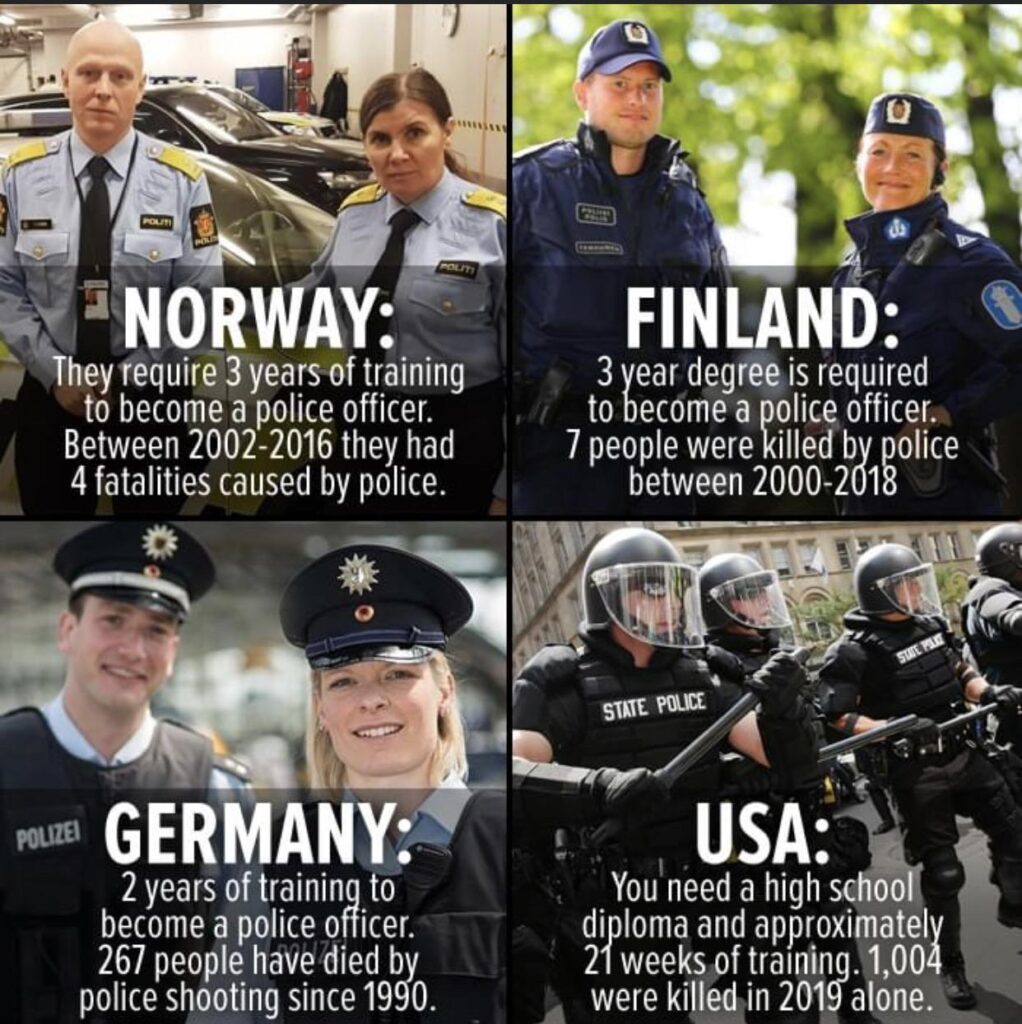
I think these kinds of incidents have always happened, but now that people can record and use surveillance footage to document them, and have platforms like Twitter and Facebook to post them publicly, we’re getting multiple, national stories every week about out-of-control law enforcement. I’m just wondering: Is there any point at which people who defend the police will ever stop saying that there are “just a few bad apples” in police departments, and start admitting that there must be a systemic problem with how America hires and trains the police?

Obligatory: ‘No Way To Prevent This,’ Says Only Nation Where This Regularly Happens This was originally written about mass shootings — and it is more applicable month after month, year after year, since it was first written — but it works just as well for policy brutality.

Posted in Politics | Tagged | Leave a comment

The REAL Reason McDonalds Ice Cream Machines Are Always Broken – YouTube

TL;DW: The McDonald’s corporation forces franchisees to purchase a particular model of Taylor ice cream machines. These ice cream machines are finicky, prone to error, and hard to diagnose, which makes franchisees call someone to repair them. By contract, only Taylor’s repair department is allowed to work on Taylor ice cream machines. It’s expensive. Service makes up 25% of their yearly revenue. There is a secret system to diagnose and repair these machines that most people don’t know about. Someone else made a device to attach to the machine, and an app to read what it detected, and started having some success at bypassing this slow and expensive repair process. McDonald’s told licensees that they could not use this system or they would void their warranty and breach their contract. Taylor is implementing a similar system, but which will continue to keep the franchisees dependent on them to fix the machines.

Gee… This sounds an awful lot like John Deere, huh? This is another good case study for the right to repair.

This is just another naked play to unethically and forcefully create a monopoly on some vertical slice of economic activity, which a perfectly-competitive version of capitalism would have fixed on its own. It’s what all companies strive for now.

Posted in Politics | Tagged , , | Leave a comment

The Ease of Tracking Mobile Phones of U.S. Soldiers in Hot Spots – WSJ

The U.S. government has built robust programs to track terrorists and criminals through warrantless access to commercial data. Many vendors now provide global location information from mobile phones to intelligence, military and law-enforcement organizations.

Source: The Ease of Tracking Mobile Phones of U.S. Soldiers in Hot Spots – WSJ

It doesn’t really matter how much protection from government overreach we write into the Constitution, if we allow companies to do the things we won’t allow the government to do, in the name of the Almighty Dollar, and then let the government get the power we deny them in the Constitution through those reprehensible actions, regardless. The whole thing has become a sham thanks to unbounded Capitalism, propped up by our government enabling Amendment-defying behavior by companies, and then looking the other way when it comes to regulating them, while reaching a hand out behind them for campaign contributions.

I just watched The Courier last night. Great movie. When I was young, I would find it so funny the way the Soviet characters would ridicule their Western antagonists, mocking capitalism and the community-destroying greed it produced. I don’t find these things funny any more, because it’s really hard for me NOT to see some truth in that kind of dialog now.

In the post-war, pre-military-industrial-complex, pre-Wall-Street-investment-bank days, I wouldn’t have argued it. Now, monstrous companies are running this country, trampling the balance of power enshrined in our founding documents, and the result has been the decimation of the middle-class, which is crucial to upward mobility. And this is, after all, the American “dream.”

We mock China for having a social score and sham elections, but we incarcerate more people per capita than any other country, and then revoke their right to vote in a system that aggressively prevents any serious change to the status quo. We fly the flag, spend millions on fighter jet passes over stadiums, sing the nation anthem, praise our armed forces, and it all seems to me to be just as jingoistic as military parades in communist countries. How is our system any better, in actual practice?

There is, at least, one important — perhaps critical — difference, but I’ll save that for another time.

Posted in Politics | Tagged , | Leave a comment

Sources and parallels of the Exodus – Wikipedia

The consensus of modern scholars is that the Bible does not give an accurate account of the origins of the Israelites. There is no indication that the Israelites ever lived in Ancient Egypt, and the Sinai Peninsula shows almost no sign of any occupation for the entire 2nd millennium BCE (even Kadesh-Barnea, where the Israelites are said to have spent 38 years, was uninhabited prior to the establishment of the Israelite monarchy). In contrast to the absence of evidence for the Egyptian captivity and wilderness wanderings, there are ample signs of Israel’s evolution within Canaan from native Canaanite roots. While a few scholars discuss the historicity, or at least plausibility, of the exodus story, the majority of archaeologists have abandoned it, in the phrase used by archaeologist William Dever, as “a fruitless pursuit”.

The biblical narrative contains some details which are authentically Egyptian, but such details are scant, and the story frequently does not reflect Egypt of the Late Bronze Age or even Egypt at all (it is unlikely, for example, that a mother would place a baby in the reeds of the Nile, where it would be in danger from crocodiles).

Source: Sources and parallels of the Exodus – Wikipedia

These are the lead graphs from the Wikipedia page on the Biblical account of the Exodus. I’ve been watching this space for a long time, with some fascination. Every few years or so, someone claims to have proven that some detail of the story could not have been correct, so, therefore, the story is pure fiction. The biggie, of course, was that the Jews could not have been slaves who built the pyramids. Rather, it is now settled scholarship that the people who built the pyramids were patriotic Egyptians, who were paid and fed well for their work for the empire.

I would assume that Wikipedia’s editors would begin the discussion of “the consensus of modern scholars” with the most-significant pieces of evidence against the narrative being factual. (Wait. I thought “science” didn’t care about consensus? I guess that’s only climate science.) Anyway, the first issue is that there was no archaeological findings to establish Jewish habitation of the Sinai peninsula.

First of all, according to the Biblical account, they only spent 38 years in that region, which happens to be a largely featureless, wind-swept desert. This is one second of time, archaeologically-speaking, in a place that would actively obfuscate evidence of passage through it. These conditions would make finding a record of them difficult in the best of circumstances.

Second of all, the Biblical narrative records that they lived as nomads, in tents, moving continually — as beduins — building no permanent structures. Most famously, the center of their mobile “city” was the Tabernacle housing the Ark of the Covenant, which was setup, torn down, and carried away at every location. In essence, they left virtually nothing behind to record their journeys.

Did these “modern” “scholars” never actually read the text they are disproving? I recognize that the position for the narrative being true is that you can’t disprove a negative, but even so, this is hardly the slam dunk they seem to think it is. There’s no contradiction with the account on this point.

Second of all, “modern” “scholars” take issue with a mother floating a baby down the Nile River due to the fear of crocodiles. Again, I have to ask: did these “modern” “scholars” even read the Bible? Moses’ mother would have put him in a basket of reeds, despite any fear of crocodiles, because not doing so meant certain death at the hands of the Egyptians.

I’m a fan of science. I’m a fan of archaeology. I’m a fan of Biblical history. There are parts of the Bible that seem incongruent to me, but most of the issues that “modern” “scholars” raise don’t seem persuasive to me. It just seems like trying to rewrite history to fit their worldview, as much as they claim is was originally written to fit the Jewish worldview. I could just as easily point to this documentary, which makes some very compelling arguments that the account is true, and that turn-of-the-century Egyptologists got the timeline wrong, and no one wants to go back and edit every book ever written on ancient Egypt.

Posted in Religion | Tagged , , | 1 Comment

Peter Thiel: Competition Is for Losers – WSJ

I am woefully late in coming to this understanding that monopoly is the goal of all venture capital. Peter Thiel, of Paypal, Palantir, Facebook “fame,” literally said this was the goal, in front of God and everyone, in a WSJ op-ed, seven years ago. Like the PG article from the other day, Thiel tells some whoppers to try to make everyone feel better about monopolies.

Even the government knows this: That is why one of its departments works hard to create monopolies (by granting patents to new inventions) even though another part hunts them down (by prosecuting antitrust cases). Source: Peter Thiel: Competition Is for Losers – WSJ

If this isn’t the most-lopsided statement I’ve ever seen, I don’t know what would beat it. First of all, the patent office does not “work hard.” An awful lot of patents are given out like candy for trivial things. Further, software patents — which I’m sure Thiel loves — have been one of the most business-stifling things to ever happen in modern history.

Second of all, the government has only ever stopped the very biggest deals. It would seem that the current “gentleman’s agreement” is that anything under about $30B isn’t worth talking about. So Microsoft buys LinkedIn and Skype and GitHub, when it doesn’t really make much sense for them to own any of them. All the FAANG companies run around, picking up interesting toys in the flea-market bins marked “less than $1B,” and the government doesn’t even bat an eye.

And the government certainly hasn’t broken up any monopolies since AT&T. Given that the “baby Bells” have all since re-merged into the duopoly of Verizon and AT&T — which, mysteriously, line up almost perfectly in their cell phone contract terms — I’m not sure that even this was worth the hassle for the customer. What I am sure of, is that lots and lots of executives pocketed lots and lots of money for all that M&A activity.

If your industry is in a competitive equilibrium, the death of your business won’t matter to the world; some other undifferentiated competitor will always be ready to take your place.

This reveals Thiel’s cognitive bias. These “undifferentiated competitors” — in his terminology — are small businesses that would make their owners a comfortable living, and provide good job opportunities in their local market. Yes, if it folds, someone else may come along and take your place. I feel that’s a humane cycle of life. Thiel thinks this is a tragic notion, when he can be the guy who provides the capital to corner a market, and then extract all the profits that would have gone to those smaller businesses.

Monopoly is therefore not a pathology or an exception. Monopoly is the condition of every successful business.

Bullcrap. Utter VC narrative-spinning bullcrap. There are millions of small businesses being run out of business or bought up to further fuel multi-national corporate behemoths, who were too big decades ago, in this twisted game to become the largest companies in the world.

History is going to judge this period in human development as the time where we either decide how big is “big enough,” or whether we become a planet of corporations instead of governments. We’re running out of time to make the call, and if we don’t, we will eventually get the latter.

You can say that it’s unethical to tell Peter Thiel, “No, you can’t have any more,” but if we find the collective will to start doing that to the billionaires of the world, in another generation, it will matter more which company you work for, than what nation you are a citizen of. It already does in China, where working for Apple — as detestable as the working conditions are to Americans — it’s still one of the best jobs in the country. It already does in Alabama, where working for Amazon was seen to be so good — despite all the press to the contrary — that they overwhelmingly rejected the call to unionize. Those people would work for Apple or Amazon no matter what country they had to do it from.

(Makes you wonder who was running all the pro-union stuff in social media, huh?)

Posted in Politics | Tagged , , , | 1 Comment

Time Tracking Web Apps

I work for a tech outsourcing firm, but I’m fully-subcontracted to a Fortune 250. My company recently switched away from their home-brew time tracking tool (which wasn’t completely terrible) to Workday. The transition was rough. You had to click several times to finish the process, and it was easy to miss. They’ve since changed the workflow, and it’s better, but the site is still laggy. Apparently, Workday is taking over the world, and this makes me sad. It’s not a great system.

The Fortune 250 recently wrote their own time tracking tool, and now I have to enter my time in this second system as well. It’s everything I’ve come to expect from an internal application written by #CorporateIT. It’s slow. Like, really slow. Every time you type a number, it does something in the background, so filling in project numbers takes several seconds. Entering a number for time takes just longer than you expect, so it’s constantly tripping you up. Did it take the number? Oh, wait, it did, and now I have 88 hours in the box. Today, it broke the tab key. So, you know that thing where you would hit 8 and then tab, five times in a row, and be done? Not happening. This is something that you get for free in a browser, which people rely on, due to muscle memory, and the way every other table-based UI works, like Excel. You have to purposely disable this behavior. This strikes me as bizarre, but I guess it doesn’t really surprise me.

I wrote attendance-taking software for my church, which we used for a dozen years. It had features we still miss now that we use one of the main church management software sites. And it was fast. Like, millisecond fast.

I wrote my own home-brew time tracking software for a previous company. The first version sucked. It was slow, too. But, after getting it “in the neck” about how bad it was, at one all-hands meeting, I took the initiative, spent a week re-designing the core of it, and made it fast. Really fast. I profiled it at literally 20 times faster. The owners were happy. And then I wrote a page to do two pivot tables for the time period, one by employee (to write paychecks) and one by customer (to write invoices), and the person who did both of those things was happy too. This saved her many hours every week. That was 11 years or so ago, and the last time I asked, they were still using it.

These systems aren’t really that complicated. This is a well-known problem space, which every company needs addressed. Why are they all so terrible? I think it all comes back to the basics. The people who have to deal with it are not the people designing it, or specifying it. Once a company is so big that this disconnect can happen, I don’t know how it ever gets fixed. I fixed my app because the owner said it sucked, and I fixed it. In a Fortune 250, no one who has the authority to say that the time-tracking app sucks will ever have to use it, or even speak to someone who has to.

Posted in Programming | Tagged | Leave a comment

jwz: ENGAGEMENT!

Every time we post to our Facebook account, it immediately gets 2-5 one-word comments from random Indian dudes with locked accounts that are years old and have thousands of friends:

Source: jwz: ENGAGEMENT!

There’s never post about Facebook on “Hacker” “News” where the comment thread isn’t filled with people saying, “I hate it too, but what do you want me to do? Never know anything that’s going on around me? There’s literally no other option.” Even JWZ himself, who abhors Facebook, still uses the platform to promote is nightclub in San Francisco. That’s how deeply ingrained the service has become to society, and how irreplaceable it is to local businesses.

This is a pitch-perfect example of what I was talking about in my previous post. This irreplaceability is precisely what all tech investment is gunning for: total control of a channel. Eliminating all competitors in the space, and establishing a monopoly. If you want to advertise some local social event, at this point, Facebook is your de facto only choice.

Right now, Uber seems like a good idea. Door Dash seems pretty nifty. WeWork sounds great. But make no mistake, once those platforms have removed all the competition in their spaces, their services will start to experience the same sort of corruption that is being described here. Scammers will flourish, as they focus their efforts. All of these services will come to feel like shopping at Amazon, where you used to be able to trust the reviews and delivery times, and now it’s just a roll of the dice on both.

Posted in Technology | Tagged , , , , , | Leave a comment

Police pull guns on and spray Black-Latino Army officer during traffic stop, lawsuit says

Two Virginia police officers have been sued for drawing their guns on a uniformed Army officer during a traffic stop and pepper spraying him.

Source: Police pull guns on and spray Black-Latino Army officer during traffic stop, lawsuit says

Is U.S. Army 2nd Lt. Caron Nazario a “good enough” person for Candace Owens to “support” as a victim for BLM?

I can feel my willpower slipping to stay off Twitter with this sort of hot take.

Posted in Politics | Tagged , , , | Leave a comment

How People Get Rich Now

The tech companies behind the top 100 fortunes also form a well-differentiated group in the sense that they’re all companies that venture capitalists would readily invest in, and the others mostly not. And there’s a reason why: these are mostly companies that win by having better technology, rather than just a CEO who’s really driven and good at making deals.

Source: How People Get Rich Now

I’m sorry, but this is pure fiction, told to one’s self to feel better about the real facts on the ground. What we’re seeing in “tech,” over and over, is not an effort to come up with “better technology,” but the play to capitalize on some particular niche, and then monopolize it. This is key.

It’s not good enough to provide nice co-working spaces; the goal is to own every rentable building in a city. It’s not good enough to provide a ride sharing solution; the goal is to run taxis out of business, and be the only ride share in town. It’s not good enough to run a respectable social media site; you have to be the only one that people use for a particular purpose. It’s not good enough to provide a food delivery service, you have to be deliver all the food in a metro area.

VC’s are not looking for the next “better mousetrap;” they’re looking for the next monopoly. That’s where all their money is going. Don’t go to Y Combinator with an idea that you think can make “X” millions of dollars per year. Go to Y Combinator with an idea to corner the market on some product or service, and make all the money for it. Established companies (like the latest $20 billion Microsoft gobble) are scrambling to own a monopoly vertical workflow stacks of their own, but it’s all the same idea at play. The only people left standing at the end of this century will be monstrous, global companies which control an entire end-to-end chains of a particular thing, or entire walled gardens that provide so much of what you want that you never step outside of them, and the only people who will be able to pull their strings are billionaires who fund them.

Unless the governments of this world suddenly find their spines, and learn how to tell a billionaire “no,” we’re heading directly for the cyberpunk, citizens-of-global-corporations future that people have been writing about for decades.

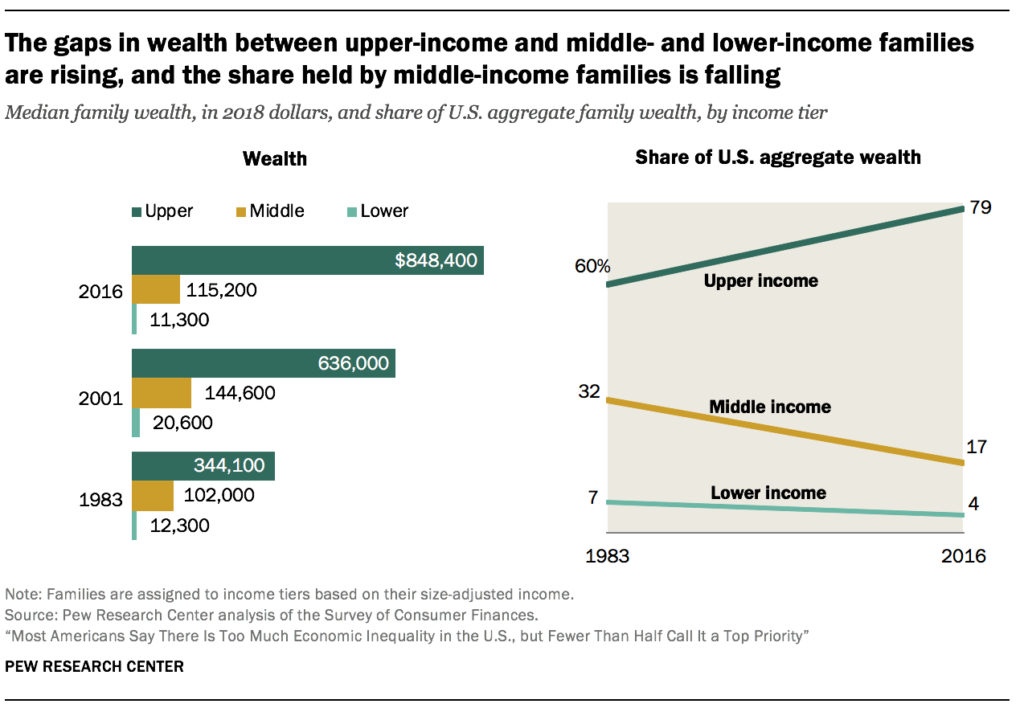
Also, this guy has a great deconstruction on the actual wealth inequality fiction Graham was spinning here. It shows how the middle class is being decimated by increasing disparity.

Paul paints a rosy picture but doesn’t mention that incomes for lower and middle-class families have fallen since the 80s. This golden age of entrepreneurship hasn’t benefitted the vast majority of people and the increase in the Gini coefficient isn’t simply that more companies are being started. The rich are getting richer and the poor are getting poorer.


Posted in Technology | Tagged , | 2 Comments