In a message to employees, Salesforce said on Friday that it will help employees and their families relocate if they’re concerned about reproductive care.
As I have been saying for awhile, which company you work for will soon matter more than which county you are a citizen of. We are truly heading for a cyberpunk version of dystopia.
Between the supply chain constraints, up and down every industry, and the wage demands being forced on companies who can’t find workers, I’ve been expecting this. I think it’s lagging, and we will find it getting much worse soon.
But how will new medicines and treatments get approved if we force American health insurance companies to sell at reasonable prices? </SpongeBob mocking> I don’t know, but maybe the hundreds of millions the insurance companies pay their executives would be a good place to find a little funding.
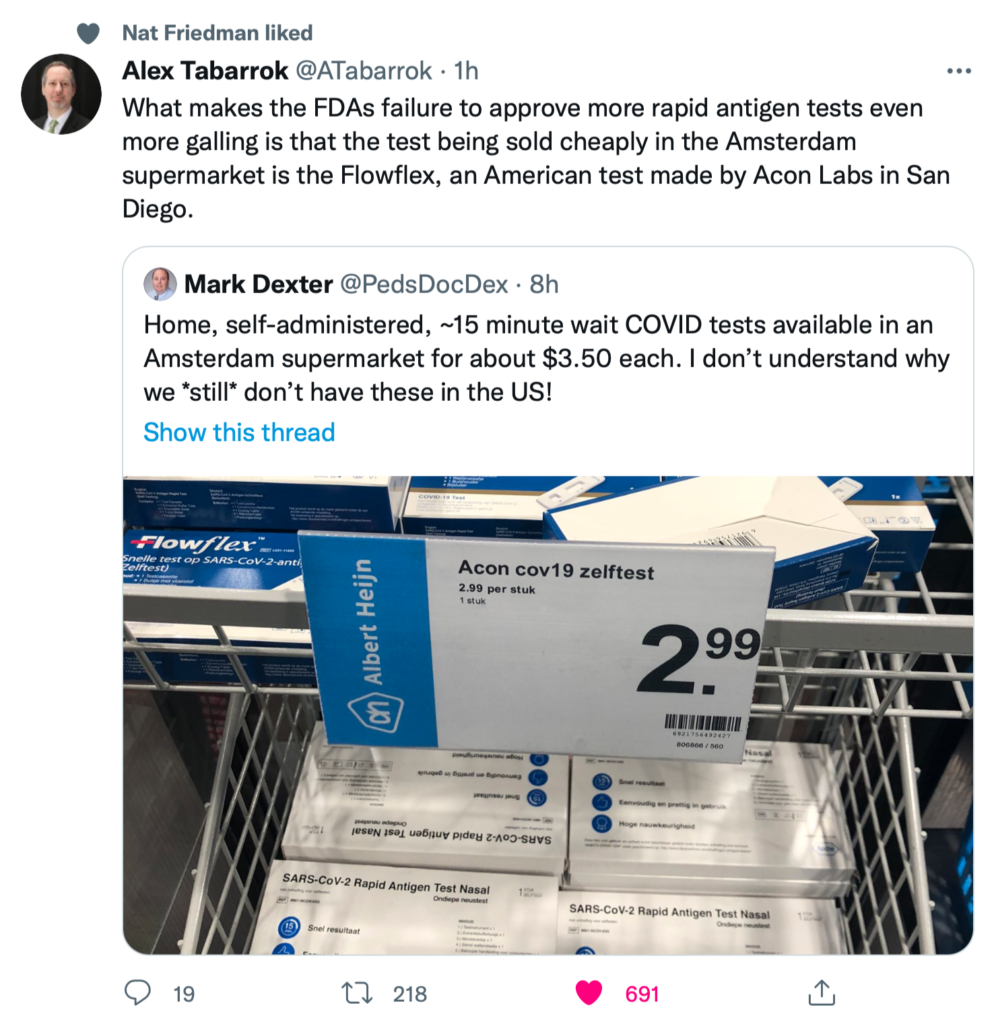
The only reason I can think of that this is not being sold in the US is to preserve cash flows for the testing being done at clinics, doctors offices, and CVS.
I finally took a look at Arch Linux. I started the process of installing it with Parallels on my MBP. I got to the GRUB configuration step, and then thought, “What in the world am I doing!?” And then I quickly deleted the VM and the install ISO. In the immortal words of Sgt. Murtaugh, “I’m getting too old for this.”
I self-hosted my “cloud” applications on my home network for years and years. It was a LOT of work. I finally gave up and gave my digital life to Google. Then I recanted Google, and gave it all to Apple, and then doubled down. When I look at the list like this, I get really unnerved about how much of my life would be lost if my Apple account got blocked, deleted, or stolen. My fallback position is that I ran Linux on the desktop for 19 years, and it works even better for the kind of work I do than macOS. I could switch back, and leave a lot of this list behind.
This is half the reason I haven’t given up on 1Password, and let Apple’s keychain have all my passwords. At least, if I lose my Apple account, I would still have my credentials to get into everything else.
I’ve been using my Apple email for my account name on web sites for several years now. I should probably go back to using my actual address, which I can forward however I like…
Whether the original post is true or not, most of us know someone who has been wracked with medical expenses. I, myself, have had around $15K of uncovered medical expenses in the past few years, not counting the out-of-pocket limits before “benefits” kick in. I can afford this, if only barely. However, the larger and inescapable truth in this country is that the vast majority of us are one cancer diagnosis away from total financial ruin.
I still think that the right way to fix the health care industry in a “capitalistic” system is to regulate the health insurance industry the same way we do car insurance. But the health insurance companies aren’t going to allow themselves to be pressured by the market, and will make sure that Congress does not change the status quo. They are quite content to let the current system continue its decline until it becomes impossible NOT to nationalize it. In my estimation, Big Insurance (like Anthem, Centene, United, and Humana) are all jockeying to get a bigger slice of the pie when the government finally steps in and makes them a department of the Executive branch.
For years, I’ve struggled with getting good networking at my house. We had our previous house custom built, and I had it wired thoroughly with CAT5 and RG-6. In my current house, there are coax drops in every room, but some are shorted, some I can’t trace, and some are shared among several outlets. It’s bizarre. There are a few RG11 ports and one RG45 — with a switch? — which I presume all go to the SBC box on the side of my house, to which I have no access.
When we first moved in, I upgraded to a monster Asus WiFi router in my office, which is in the basement. It was OK in the basement, and on the main floor, but spotty on the second floor, of course. Then it burned out. No problem, right? These days, there are lots of mesh WiFi systems on the market.
My next move was to get a Netgear Orbi. It worked, sort of. The problem was that it needed to be rebooted every few days. After months and months of this hassle, and one day where I had to reboot the stupid thing multiple times in a single day, I finally — literally — unplugged the unit in my office, and smashed it on the floor, to force myself to do something else.
I drove straight over to Best Buy, and bought a Linksys Velop, and… immediately regretted my life choices. Linksys’ setup application is even worse than Netgear’s. It’s a clown show of an IoT piece of junk. I fought through it, and finally got the system setup, and the speeds were decent. However, I found that every time I looked at the status on the app, the “middle” floor unit was offline, and needed to be rebooted. Then, one day, the whole system lost its mind, and needed to be re-setup from scratch. I continued to put up with these hassles, rebooting the one unit, and occasionally needing to reset a node.
This is where this story, and its followup, fits into this timeline.
Lest you think my experience with the Velop is an aberration, a good friend of mine has worked for many, many hours with Linksys tech support on his system, and after getting sent several particular firmware versions to try, was recently sent an entirely new set of units.
I had an Aha! moment, and bought 2 pairs of TP Link Powerline adapters to run a “backhaul” line for each of the 2 remote WiFi access points. This seemed to work better. The main floor unit stopped going offline. I thought I was finally on easy street.
Then one day, the entire system lost its mind again. The Comcast service had “locked up” on my modem — again — but this seemed to cause the Velop to not only stop working, but lose its configuration. Given how the setup app basically doesn’t work unless it can “phone home,” I guess it scrammed itself because of this. Whatever the reason, I found this completely unacceptable. I had to get WiFi working again, but I could only pair one of the secondary units. The other just completely refused to work again.
So I ordered a Ubiquiti Dream Machine, and 2 of their NanoHD access points. I use a lot of their gear for networking and security cameras at our church, and it’s not without a learning curve specific to their way of working, but since I knew what I was getting into, and I could afford it, I figured this was my only option left. At this point, I am convinced that all consumer-grade mesh systems on the market are just rubbish. I wasn’t willing to try Amazon’s or Google’s, or whatever. I thought that my existing Powerline adapters would provide the wired connection for the wired-only AP’s to get to the router.
I got the thing all setup, but my speeds were lacking. I pay for gigabit, but I don’t worry much about getting the whole thing. I know that’s not realistic. However, I tried to play Battlefield again, after a long hiatus, and I kept lagging out. Like, every minute. I realized that my Comcast setup was just not working right. Turns out that I was only getting 200 Mbps, and even that was spotty. I spent several hours trying different things and talking to their tech support — twice — and finally got them to straighten it out.
Then I tried to get my son to play Battlefield with me, and he kept lagging out. So I started working on the inside part of the network. I saw that TP Link offers an application to look at their Powerline adapters, and it will report the bandwidth you’re actually getting. I saw that my “backhaul” connections were only getting 100-200 Mbps. In effect, these adaptors were doing exactly what I needed them to do with the Velop: they kept the systems talking just enough to keep them from dropping offline, but continued to use the “mesh” for the actual WiFi traffic. Anyway, I reconfigured the 2 pairs into a single, 4-node network, hoping that this would improve the situation, but it made no difference. In the same room, power line adapters will get near their advertised 2 Gbps, but once you put them across circuits in your house’s electrical panel, the bandwidth is cut by a factor of 10.
In the beginning, I had used a pair of ActionTec coax adaptors to extend my network over to my boys’ PC’s, when they were in the basement. However, the unit I had was capped at 100 Mbps. I wanted to try the new ones rated for gigabit, but was nervous that they would work only as well as the Powerline adaptors. But the Amazon reviews — which, I know, goes against everything I believe about Amazon and ratings systems in general — kept saying that power line adaptors weren’t all they were cracked up to be, and that these were the real deal, and I believed them. So I bit the bullet, fully prepared to send them back. After a lot of tracing and fiddling, I got them setup where they could reach my access points, and they worked… great! This was the final straw to making everything work. They don’t have an app to look at effective bandwidth, but testing from my son’s Playstation shows that he can get 800+ Mbps all the way out the door.
And I haven’t lagged since.
I find myself looking at my Ubiquiti dashboard, and reveling in WiFi nirvana. I can’t believe how much money I’ve spent getting to this point, but now that it’s working like I expect, and it hasn’t missed a beat for many days now, so it feels like it’s been worth it.
To their credit, another friend has Ubiquiti’s Amplifi mesh product, and he says it’s been flawless for him. I was tempted to try their “Alien” version, with multiple units in a mesh configuration, but that would have been even more expensive than what I’ve got now.
I just watched this documentary, and it was terrific, as a movie, and a biopic. A couple of things stuck out to me during the viewing. The first was how Steve Jobs funded Pixar, to the tune of $1M for 5 years. This wasn’t a lot of money for him. This wasn’t a lot of money to run a business on. The amount of money wasn’t interesting from either side. The process was the significant bit. In essence, this was venture capitalism in its infancy. Apparently, in 1990, this was novel.
This is the way the whole world works now. The entire empire of Amazon was built on burning VC money until they became the online titan they are now. For 20 years, they chewed through capital until they couldn’t be challenged. For Jobs and Pixar, it only took 5 years until they proved their “product” was great, via the massive success of Toy Story. One week after the release of the movie, they took the company public, in a reportedly wildly successful IPO, and Jobs cashed out.
The author says, “I’ve stopped using Reddit mostly because I no longer wanted to support a site that has aggressively started to employ disrespectful design patterns.” Excuse me, but “started?” They’ve been going down this road for years. I’ve stopped using Reddit entirely, and have the site blocked on my network, so that I can’t inadvertently give them traffic by clicking through a search result, as they have obviously paid through the nose for placement these days! Just about everything I search on has at lease one Reddit link in the first page of results. For awhile, I would click through to the page, wait for the site to load it’s 100 MB of scripts, dismiss the popups, expand the answers, and see what Google had supposedly found, but I gradually realized there is never a good answer on the site. Technical discussions are not what people are doing on the site.
500 comments on the HackerNews discussion about this post, and these are the only comments about porn:
This exchange is utter nonsense. Reddit is filled with porn. Thousands and thousands of subs are dedicated to it. If you have an account, and allow NSFW content — and take note that most of the viral posts on the site are marked NSFW, encouraging you to do so, even if you don’t necessarily want to look at porn — all it takes is one search on the site, and you can instantly infer how much of it there is. Yes, a lot of it is come-ons for someone’s paid site, but there is a virtually limitless supply of free, high-quality porn to accommodate everyone’s tastes.
No one wants to admit this. I will. I’ve had a look around. It’s bewildering how much of it there is, and how specific it can be. I’ve brought it up many times in various HN discussions, and no one even wants to acknowledge it. The exchange above is a perfect example of just ducking the issue entirely. In fact, the exact inverse of what’s stated here is true: Reddit is a porn site, with some user-interest topics (like gaming, audiophile headsets, or mechanical keyboards) to keep you engaged between wanks. One of these days, I expect PornHub to take a note, and start forums on their site about whatever people want to talk about. Who knows? Maybe they already do. I’ve not “researched” that site.
A thermocline is a distinct temperature barrier between a surface layer of warmer water and the colder, deeper water underneath. It can exist in both lakes and oceans. A thermocline can prevent dissolved oxygen from getting to the lower layer and vital nutrients from getting to the upper layer.
In many large or even medium-sized IT projects, there exists a thermocline of truth, a line drawn across the organizational chart that represents a barrier to accurate information regarding the project’s progress. Those below this level tend to know how well the project is actually going; those above it tend to have a more optimistic (if unrealistic) view.
This is all true, but the article assumes that everyone is acting rationally, in service to the stated goal(s) of the project, and that problems with the timeline are just honest mistakes. Unfortunately, in my 25 years, I’ve witnessed a nauseating amount of political infighting that sought to undermine projects in attempts to build and/or preserve personal power. This behavior employs the two things readily at-hand for ruining estimating: bad-faith technical decisions, and good, old-fashioned feet dragging. So the problem isn’t just people being wrong, there’s also a large component due to people actively sabotaging a project for their own purposes.
I’ve spent most of my career in Fortune 250’s, but I’ve seen this happen in a couple of very small companies too. As someone with a personality that is honest to a fault, this has caused me a significant amount of distress in my career. More than once, I’ve been the lone voice in the wilderness crying about the forthcoming train wrecks, only to be ignored, and then ultimately blamed for the crash, because I was the only one that people could point to for having said anything about it at all.
I was born at the perfect time to pursue a career in full-stack software development. I grew up programming 8-bit computers, then learned Unix in college. I entered the workforce at the emergence of Windows for Workgroups and Linux, and I'll be retiring right about the time the AI's make me redundant. Also, the year Social Security goes broke.
Months and months of planning by lots and lots of middle management can save literally hours of programming.
Me
Give a man a program, and you'll frustrate him for a day. Teach a man to program, and you'll frustrate him for a lifetime.
Unknown
I have a mental illness that makes me think that people will change their minds if I present the correct arguments with the appropriate facts and data.
@xxclusionary, on Twitter
I've put all of my skill points into arguing with blinking lights.
Me
But I say unto you, that whosoever looketh on a new piece of Apple gear, to lust after it, hath committed purchase of it already in his heart.
Me
Don't say you're easy on me; you're about as easy as a nuclear war.
Duran Duran, Is There Something I Should Know
I sold the Renoir and the TV set; don't wanna be around when this gets out.